








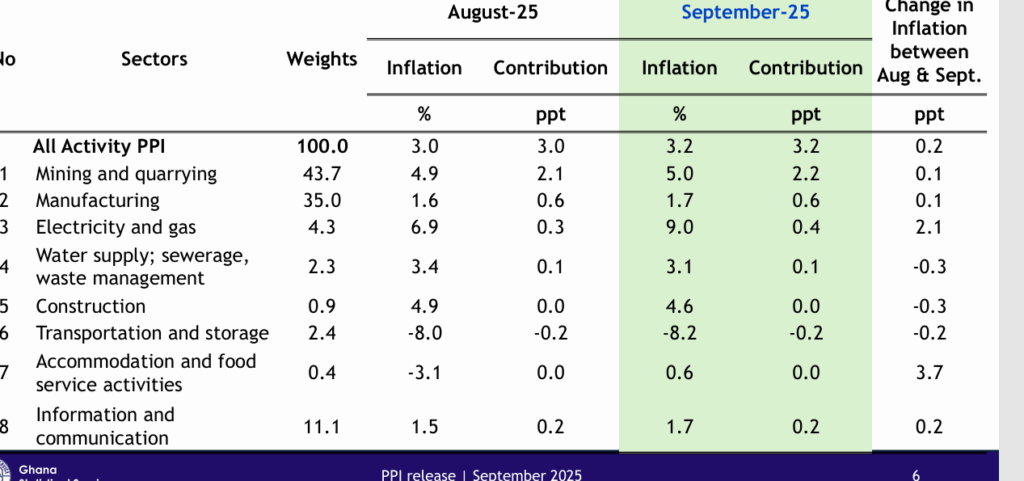
Ghana’s producer price inflation (PPI) slowed to 3.2% year-on-year in September 2025, according to new data from the Ghana Statistical Service (GSS).
The figure represents a 0.2 percentage point rise from August 2025’s 3.0%, but a sharp 27.3 percentage point drop from the 30.5% recorded in September 2024.
While this dramatic fall signals a cooling of inflationary pressures at the producer level, it also raises important questions about whether Ghana’s industrial base is merely stabilising — or stagnating under weak demand and cost constraints.
📢 GET DETAILED ARTICLES + JOBS
Join THSB's WhatsApp Channel and never miss a post or opportunity.
A Closer Look at the Numbers
The month-on-month change in producer prices between August and September 2025 was 0.9%, meaning producers received slightly higher prices for their goods and services compared to the previous month.
The sectoral breakdown tells a more nuanced story:
-
Mining and Quarrying, the largest sector with a 43.7% weight, inched up from 4.9% to 5.0% — a modest 0.1 percentage point rise, reflecting relative stability in extractive output.
-
Manufacturing, which accounts for 35% of the PPI, also saw a mild increase from 1.6% to 1.7%, suggesting supply cost moderation but limited price power among producers.
-
Transport and Storage, however, continued to experience sharp deflation, with prices falling 8.2% in September compared to 8.0% in August — indicating weaker logistics demand or possible price corrections in freight and fuel services.
Overall, the data shows narrow price adjustments across sectors, consistent with a period of macroeconomic cooling.
What the Numbers Mean for Business
The GSS recommends that businesses use this window of low inflation to boost efficiency rather than simply celebrate lower input costs.
“Cut waste, boost efficiency, and reinvest savings in technology and skills,” the GSS advised.
With inflation pressure easing, firms have an opportunity to restructure operations, invest in process automation, and retrain workers to drive productivity.
However, producers must remain cautious. The muted price growth could also signal weak consumer demand, especially if household incomes are not keeping pace with inflation adjustments at the retail level.
Policy Actions and Economic Strategy
The GSS made several practical recommendations for policymakers:
-
Tax reliefs to reduce production costs and stimulate industrial competitiveness.
-
Energy and transport reforms to ease structural bottlenecks in logistics and power supply.
-
Strengthening local supply chains to lower import dependency and improve resilience against global price shocks.
If implemented, these measures could help Ghana’s producers sustain growth while insulating them from future inflation volatility.
For Households and Consumers
The GSS also extended advice to households, encouraging responsible consumption and value-conscious spending:
“Spend with intention to stretch income and reward fair pricing.”
This consumer discipline, combined with market transparency, can create downward pressure on prices and help sustain low inflation levels.
Beyond the Numbers: Stabilisation or Slowdown?
At face value, Ghana’s PPI decline is good news — it suggests inflation expectations are moderating and cost pressures are easing across key sectors.
But when inflation slows this dramatically, it also invites another question: is growth slowing too?
The minimal movement in manufacturing prices hints that demand may be soft, while the drop in transport prices could reflect lower economic activity.
The real challenge for Ghana’s economy will be turning price stability into productivity-driven expansion. That means using this low-inflation period not as a comfort zone, but as a springboard for industrial revival, export diversification, and investment attraction.
Source: Accra Business News
Disclaimer: Some content on The High Street Business may be aggregated, summarized, or edited from third-party sources for informational purposes. Images and media are used under fair use or royalty-free licenses. The High Street Business is a subsidiary of SamBoad Publishing under SamBoad Business Group Ltd, registered in Ghana since 2014.
For concerns or inquiries, please visit our Privacy Policy or Contact Page.

Samuel Kwame Boadu is a Ghanaian entrepreneur, writer, and digital consultant passionate about creating impactful stories and business solutions. He is the Founder & CEO of SamBoad Business Group Ltd, a dynamic company with subsidiaries in digital marketing, logistics, publishing, and risk management.