





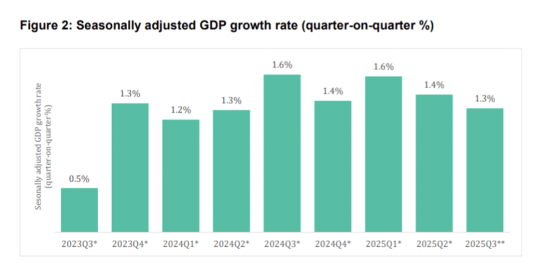
The economy grew by 5.5 percent in the third quarter of 2025, keeping up the steady pace seen throughout the year, even though it was slower than the 7 percent growth in the same period of 2024. According to fresh data from the Ghana Statistical Service (GSS), agriculture and services posted strong gains, while ongoing weakness in oil and gas dragged down industrial output.
The seasonally adjusted Gross Domestic Product (GDP) grew by 1.3 percent from the previous quarter, just shy of the 1.4 percent increase seen in the second quarter.
Growth was mainly driven by information and communication, crops, trade, transport and storage, as well as manufacturing. Meanwhile, mining and quarrying, health and social work, accommodation and food services, and other personal services saw declines.
📢 GET A DETAILED ARTICLES + JOBS
Join SamBoad's WhatsApp Channel and never miss a post or opportunity.
Government Statistician Dr. Alhassan Iddrisu reported that nominal GDP hit GH¢339.4 billion for the quarter, up from GH¢293.1 billion in the same period last year. He explained that the 15.8 percent rise was due to both increased output and changes in prices.
“On the real side, the economy produced GH¢50.8billion worth of goods and services in quarter three of 2025 compared to GH¢48.2billion last year,” he said.
“This gives us a real GDP growth rate of 5.5% for quarter-three of 2025. Growth is still positive, but slower than the same period last year,” he added.
Non-oil GDP rose 6.8 percent, demonstrating continued resilience of activities outside the petroleum sector.
Dr. Iddrisu said the data show that “Ghana continues to rely less on oil and gas to drive its economy”, even though non-oil expansion eased slightly from 7.8 percent a year earlier.
Agriculture was the strongest performer, expanding 8.6 percent on the back of growth in fishing and crops. The sector accounted for roughly 30 percent of the total expansion.
“Even with its modest share of the economy, agriculture’s contribution to growth was outsized,” Dr. Iddrisu said, adding that the improvement supports food supply conditions and household purchasing power.
Services, which make up nearly 40 percent of GDP, rose 7.6 percent and contributed almost 60 percent of the quarter’s total growth. ICT expanded 17 percent, with trade, transport and education also recording gains.
The Government Statistician said ICT, crops, transport & storage, manufacturing & education together accounted for about 86 percent of total GDP growth.
Industry grew 0.8 percent as an 18.2 percent contraction in oil and gas offset gains in manufacturing. Dr. Idrissu said the extractive sector’s downturn “dragged the entire industry sector down”, given industry’s 32.1 percent share of the economy.
He noted that stabilising industrial output, particularly oil and gas, will be important to sustain momentum into 2026.
High-frequency data
The Statistical Service also released updated high-frequency data, with the monthly indicator of economic growth rising 5.3 percent in September. The July–September readings align with the quarterly performance.
Dr. Iddrisu said the tool “provides early detection of economic turning points” and will be updated as more administrative data arrive.
The Bank of Ghana (BoG) also reported encouraging signs. During its latest Monetary Policy Committee meeting, Governor Dr. Johnson Pandit Asiama noted that the Composite Index of Economic Activity (CIEA) grew by 9.6 percent by the end of September, up from 2.9 percent in the same period last year..
He said industrial production, trade, private-sector credit and consumption drove the increase.
“The confidence surveys reflected continued optimism on current and future economic conditions,” Dr. Asiama said.
He added that the Purchasing Managers’ Index improved due to new orders, indicating stronger underlying activity.
With inflation on a steady decline and the buildup of reserves supporting the currency, the MPC lowered the policy rate by 350 basis points to 18 percent.
At the meeting, Dr. Asiama said the prevailing high real rates “provide scope to ease policy to further boost the growth recovery efforts”, though the Bank will monitor risks to the outlook.
Dr. Iddrisu encouraged households to start rebuilding their savings as food conditions get better and advised businesses to focus investments on ICT, trade, transport, and manufacturing. He also emphasized that the government should work on stabilizing the oil and gas sector while boosting high-growth industries to keep the economy moving forward.
Source: The High Street Business
Disclaimer: Some content on The High Street Business may be aggregated, summarized, or edited from third-party sources for informational purposes. Images and media are used under fair use or royalty-free licenses. The High Street Business is a subsidiary of SamBoad Publishing under SamBoad Business Group Ltd, registered in Ghana since 2014.
For concerns or inquiries, please visit our Privacy Policy or Contact Page.