







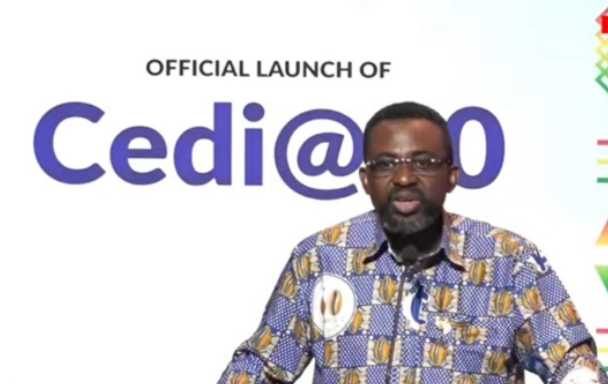
ACCRA — The Bank of Ghana has launched a year-long commemoration of the national currency’s 60th anniversary, portraying the cedi as a pillar of Ghana’s sovereignty and a symbol of economic resilience following years of turbulence and recovery.
Dubbed “Cedi@60” and themed “60 Years of the Cedi: A Symbol of Sovereignty, Stability and Economic Resilience,” the initiative seeks to deepen public appreciation of the currency’s journey and its role in Ghana’s economic development. The programme will include nationwide exhibitions, school tours, public lectures, and community forums.
Speaking at the national launch in Accra, Governor Dr. Johnson Pandit Asiama said the milestone offers a moment for reflection — not just celebration.
📢 GET DETAILED ARTICLES + JOBS
Join THSB's WhatsApp Channel and never miss a post or opportunity.
“The cedi is far more than a currency,” Dr. Asiama said. “It is a trusted store of value, a driver of economic activity, and a daily emblem of our collective confidence.”
Tracing the currency’s six-decade history — from its 1965 debut replacing the Ghanaian pound to the redenominations of 1967 and 2007 — Dr. Asiama said each phase reflects Ghana’s effort to modernize its financial system while preserving monetary independence.
He acknowledged that the cedi’s trajectory mirrors Ghana’s broader economic struggles: inflationary spikes, fiscal strain, and depreciation. In 2022, the cedi lost more than half its value, inflation soared to 54 percent, and household budgets were stretched thin.
“The cedi’s story cannot be separated from the story of our economy,” he noted. “But that was not the end of our story.”
Dr. Asiama credited improved policy coordination under President John Dramani Mahama for restoring stability. Inflation has since fallen to 9.4 percent as of September 2025, while the cedi has appreciated 37 percent year-to-date, making it sub-Saharan Africa’s best-performing currency, according to World Bank data. Ghana’s foreign reserves have also climbed above US$12 billion, offering a cushion against external shocks.
The governor attributed the turnaround to tighter fiscal management and a prudent monetary stance but cautioned against complacency.
“We are not yet where we want to be, but we are no longer where we were,” he said. “Cedi@60 is not merely ceremonial — it challenges us to protect the stability we’ve earned.”
Delivering the keynote address, Vice President Prof. Naana Jane Opoku-Agyemang hailed the currency’s recovery as a marker of credibility and resilience.
“According to Bloomberg, the cedi — once the world’s worst-performing currency in 2022 — is now the best-performing in 2025,” she said.
Prof. Opoku-Agyemang emphasized continued fiscal prudence and central bank independence, warning that confidence in the cedi “will not sustain itself” without responsible governance.
“No more reckless borrowing or deficits that burden future generations,” she cautioned.
She also spotlighted the eCedi, the central bank’s digital currency initiative, as key to the future of Ghana’s financial ecosystem.
“Once fully scaled, the eCedi will modernize payment systems and ensure that even in a cashless economy, the cedi remains relevant,” she said.
The year-long celebration, blending history, education, and technology, aims to rekindle national trust in the currency.
As Dr. Asiama concluded:
“A currency stands strong not because of what it’s printed on, but because the people who use it believe in it.”
Source: The High Street Business
Disclaimer: Some content on The High Street Business may be aggregated, summarized, or edited from third-party sources for informational purposes. Images and media are used under fair use or royalty-free licenses. The High Street Business is a subsidiary of SamBoad Publishing under SamBoad Business Group Ltd, registered in Ghana since 2014.
For concerns or inquiries, please visit our Privacy Policy or Contact Page.

Samuel Kwame Boadu is a Ghanaian entrepreneur, writer, and digital consultant passionate about creating impactful stories and business solutions. He is the Founder & CEO of SamBoad Business Group Ltd, a dynamic company with subsidiaries in digital marketing, logistics, publishing, and risk management.