





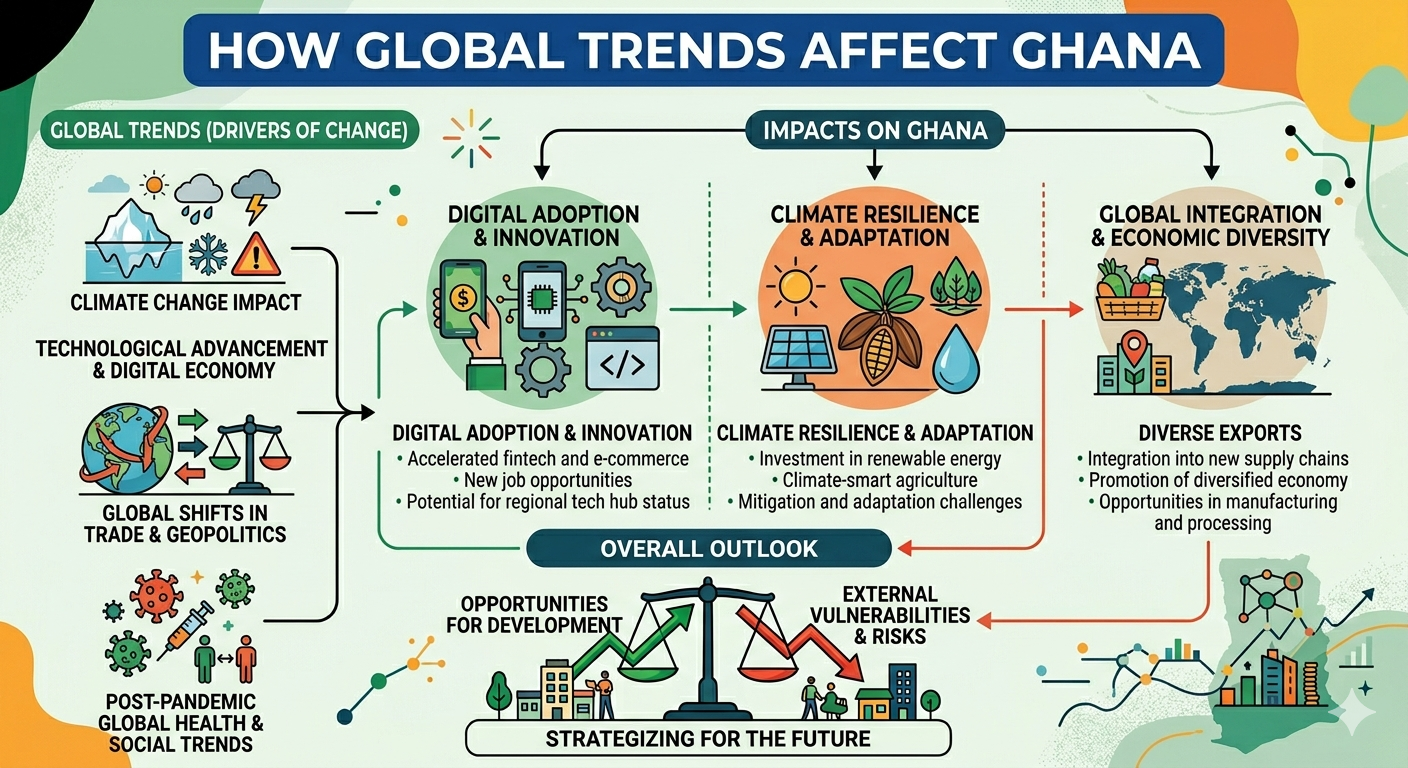
How Global Trends Affect Ghana – Global economic trends, from oil prices to interest rates, have a direct impact on Ghana’s economy. Here’s how international developments shape local businesses and daily life.
How Global Trends Affect Ghana
Ghana’s economy is deeply connected to the global system through trade, finance, and investment. This means events beyond its borders—such as changes in commodity prices, global interest rates, and geopolitical tensions—can have significant local effects. Policymakers, including the Bank of Ghana, and international partners like the International Monetary Fund, closely monitor these trends to guide economic decisions.
Commodity Prices and Export Earnings
Ghana is a major exporter of commodities such as gold, cocoa, and oil. Changes in global prices for these products can directly affect national revenue.
📢 GET DETAILED ARTICLES + JOBS
Join THSB's WhatsApp Channel and never miss a post or opportunity.
When prices are high, export earnings increase, boosting government revenue and strengthening the economy. However, when prices fall, revenue declines, putting pressure on public finances and economic growth.
This reliance on commodities makes Ghana vulnerable to fluctuations in global markets.
Global Oil Prices and Fuel Costs
Oil prices on the international market have a direct impact on fuel costs in Ghana. When global oil prices rise, transportation and production costs increase locally. This often leads to higher prices for goods and services, contributing to inflation.
Conversely, lower oil prices can ease cost pressures and provide some relief for both households and businesses.
International Interest Rates and Borrowing
Global financial conditions also play a major role in Ghana’s economy. When major economies—such as the United States—raise interest rates, borrowing becomes more expensive globally. For Ghana, this means higher costs when accessing international loans or issuing bonds.
Higher global interest rates can also lead to capital outflows, as investors move funds to markets offering better returns. This can put pressure on the Ghanaian cedi and financial markets.
Exchange Rate Pressures
Global trends often influence the value of the Ghanaian cedi. For example, a strong US dollar can weaken other currencies, including the cedi. This makes imports more expensive and can increase inflation.
Efforts by the Bank of Ghana to stabilise the currency are often shaped by these external pressures.
Trade and Supply Chain Disruptions
Global events—such as pandemics, conflicts, or logistical challenges—can disrupt supply chains. For Ghana, which relies on imports for many goods, these disruptions can lead to shortages and higher prices. Businesses may struggle to access raw materials, affecting production and sales.
Recent global supply chain challenges have highlighted the importance of strengthening local production.
Inflation Imported from Abroad
Not all inflation is generated locally. Ghana can experience “imported inflation” when global prices rise. For instance, increases in the cost of food, fuel, or raw materials on international markets can drive up local prices. This makes it harder for policymakers to control inflation using domestic tools alone.
READ ALSO: What Rising Commodity Prices Mean For Ghana
Foreign Investment Flows
Global investor sentiment also affects Ghana’s economy. During periods of global uncertainty, investors tend to move funds to safer markets, reducing investment flows into emerging economies like Ghana.
However, when global conditions are favourable, Ghana can attract increased foreign direct investment, supporting growth and job creation.
Regional and Continental Opportunities
While global trends present challenges, they also create opportunities. Ghana’s participation in the African Continental Free Trade Area positions it to benefit from increased intra-African trade. As global supply chains shift, regional trade agreements can help cushion external shocks and open new markets for Ghanaian businesses.
Policy Responses and Adaptation
To manage global influences, Ghana’s policymakers adopt a range of strategies. These include diversifying the economy, strengthening local industries, and maintaining prudent fiscal and monetary policies. Support and guidance from institutions like the International Monetary Fund also play a role in shaping responses to global challenges.
Adaptability is key to navigating an increasingly interconnected world.
Conclusion From THSB
Global trends have a powerful influence on Ghana’s economy, affecting everything from fuel prices and inflation to investment and exchange rates.
While these external forces are beyond direct control, understanding their impact helps explain changes in the local economy. By adapting policies and strengthening resilience, Ghana can better navigate global shifts and position itself for sustainable growth.
Source: The High Street Business
Disclaimer: Some content on The High Street Business may be aggregated, summarized, or edited from third-party sources for informational purposes. Images and media are used under fair use or royalty-free licenses. The High Street Business is a subsidiary of SamBoad Publishing under SamBoad Business Group Ltd, registered in Ghana since 2014.
For concerns or inquiries, please visit our Privacy Policy or Contact Page.

Esther Aku-Sika is a content writer and social media strategist who helps brands and startups grow through intentional storytelling and practical marketing strategies. With a keen eye for trends and audience behavior, she shares business insights, content strategies, and real-life lessons to help entrepreneurs build visibility and turn ideas into income. Through her writing, she simplifies complex concepts and equips readers with actionable steps to grow in today’s digital space.