









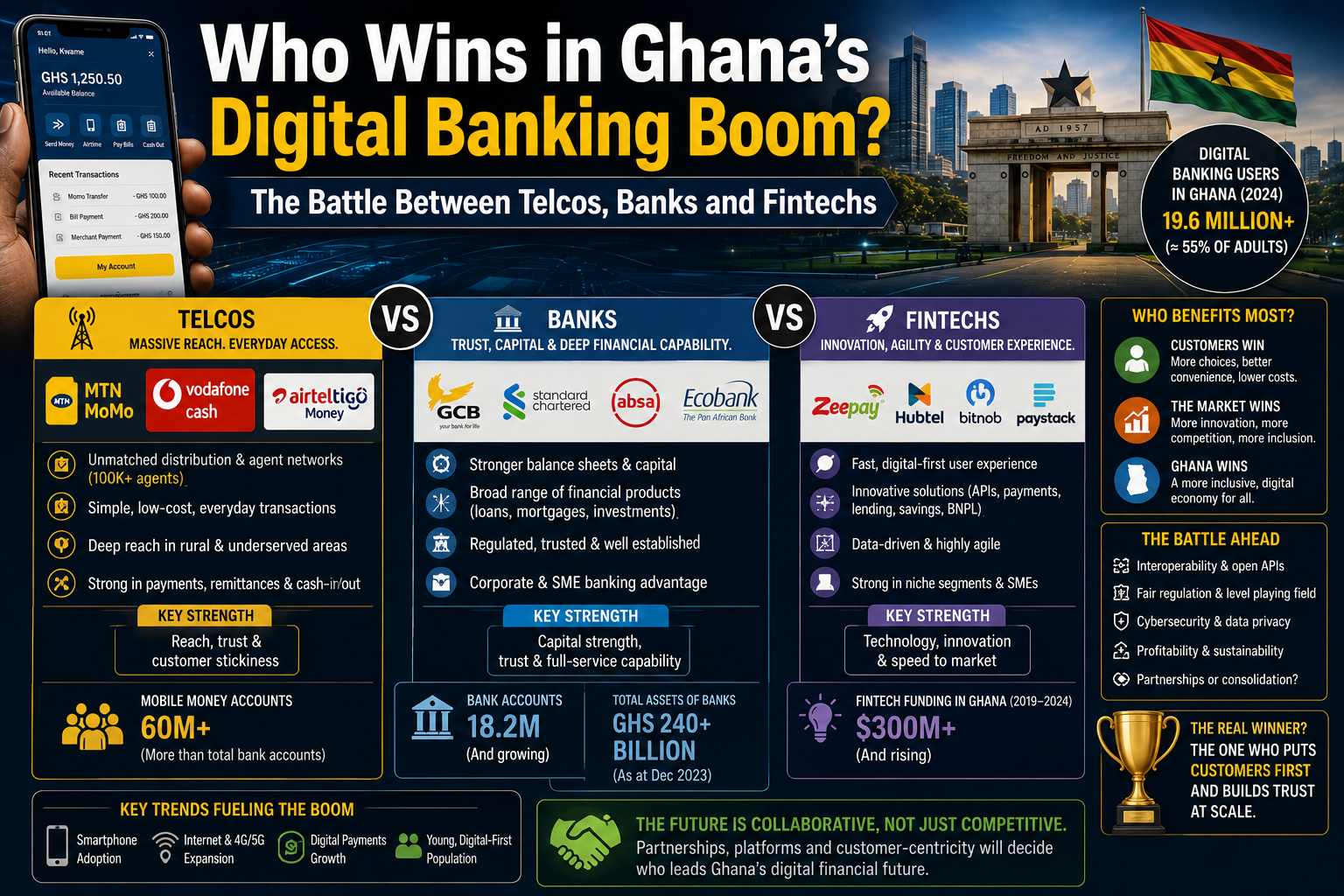

GH¢493bn in monthly mobile transactions, but who profits? Our deep-dive analysis reveals GhanaPay vs MTN MoMo, open banking, cybersecurity directives and the battle for Ghana’s digital financial future.
Who Wins in Ghana’s Digital Banking Boom?
The numbers are staggering, but they barely tell the story. In April 2026 alone, mobile money transactions in Ghana reached GH¢493.2 billion — a monthly volume that exceeds the country’s entire annual GDP. Registered mobile money accounts have climbed to 83 million, far surpassing Ghana’s adult population of roughly 20 million. Mobile money usage among Ghanaians has surged to 80 per cent, while ATM and bank app usage declines for the second consecutive year.
The message is unmistakable: digital finance is no longer the future of Ghanaian banking. It is the present. And the quiet transformation underway has profound implications for every participant in the financial ecosystem.
📢 GET DETAILED ARTICLES + JOBS
Join THSB's WhatsApp Channel and never miss a post or opportunity.
But here is the question that the headline figures obscure: What is the real business behind Ghana’s digital banking boom? Who is winning, who is losing, and how is money actually being made?

The answers reveal a complex, multipolar battlefield. On one side stand the telco-led mobile money operators — MTN MoMo, Telecel Cash and AT Money — which have captured over 97 per cent of digital transaction volume and become the primary interface between Ghanaians and their money. MTN Ghana’s mobile money revenue surged to $549.15 million in 2025, advanced services grew 55.9 per cent, and the platform has become the group’s third largest global market behind South Africa and Nigeria.
On the other side, traditional banks are waking up to an uncomfortable reality: they have been displaced from everyday payments. Bank digital channels account for less than 1 per cent of digital transaction volume. The Ghana Association of Banks acknowledged in its 2026 Industry Outlook that the rapid expansion of mobile money has “gradually displaced traditional banks from everyday economic activity.
But banks are not surrendering. In January 2026, the Bank of Ghana launched GhanaPay — a bank-owned digital wallet with zero peer-to-peer transfer fees, direct bank account linkage, and features no telco wallet can match. The Ghana Association of Banks is positioning it as a survival strategy, a deliberate attempt to recapture the retail payments interface.
Beyond the front line, a deeper shift is underway. The Bank of Ghana published a Draft Open Banking Directive in January 2026, setting the stage for third-party fintechs to access customer data and offer competing services. The central bank is extending its digital finance agenda beyond payments into digital credit, embedded finance and cross-border fintech operations. A new cyber security directive extends regulatory reach to fintechs and payment service providers. New players are entering the market: Fincra secured an Enhanced Payment Service Provider (EPSP) licence in May 2026, gaining direct regulated access to Ghana’s financial system.
This profile goes inside Ghana’s digital banking boom to reveal the economics beneath the hype. It examines the strategic moves of major banks, the competitive threat of telco-led wallets, the potential of GhanaPay, the promise of open banking, and the real business models that will determine who profits in the next phase of Ghana’s digital finance revolution.
The Market at a Glance: The State of Ghana’s Digital Finance
Before examining the players, one must understand the scale of the market they are fighting over.
Mobile Money Dominance: Mobile money now processes over 97 per cent of digital transaction volumes in Ghana and accounts for 72 per cent of total transaction value. In April 2026, mobile money recorded 967 million transactions worth GH¢493.2 billion. By comparison, cheque transactions — once the backbone of formal payments — recorded a value of just GH¢36.6 billion in the same month, less than eight per cent of what mobile money processed.
Agent Network as Physical Backbone: The distribution network supporting this digital economy has expanded to 992,000 registered agents, of whom 534,000 are active. These agents are the physical interface between digital wallets and cash, enabling millions of Ghanaians without traditional bank accounts to access formal financial services.
Financial Inclusion Gains: Ghana’s financial inclusion rate has reached 81 per cent, driven largely by mobile money agents and basic phone-based transactions. The Bank of Ghana has stated that interoperability between mobile money platforms has created a unified payments system, strengthening digital finance as national infrastructure.
The Bank Digital Challenge: While mobile money has surged, traditional bank digital channels have stagnated. ATM weekly usage dropped from 50 per cent in 2024 to 44 per cent, while bank app usage has also declined as users shift to mobile money for routine transactions.
Transaction Growth Trajectory: The total value of mobile money transactions rose from GH¢484.6 billion in March 2026 to GH¢493.2 billion in April 2026, demonstrating sustained momentum. Transaction volume increased 18.4 per cent over 2025 to 8.4 billion transactions. Interoperable mobile money transaction value rose 87 per cent over the course of 2025, with volumes up 45 per cent, reflecting expanding cross-network usage between mobile money operators and commercial banks.
Banking Sector Scale: The financial sector’s total assets stood at GH¢647.25 billion by end-2025, representing approximately 45.1 per cent of GDP. Total bank deposits rose to GH¢325.3 billion. The non-performing loan ratio declined to 18.7 per cent in February 2026 from 22.6 per cent a year earlier. The banking sector remains solvent and profitable, but asset quality continues to attract supervisory attention.
How Digital Banking Makes Money: The Evolving Business Model
To understand the real business behind the boom, one must understand how banks and mobile money operators actually generate revenue from digital services.
1. Transaction Fees (Declining Importance for Banks, Dominant for Telcos)
For mobile money operators, transaction fees remain the primary revenue source, though the mix is shifting. In 2025, withdrawals declined as a share of MTN MoMo’s revenue, dropping from 51.2 per cent to 45.6 per cent. Peer-to-peer transfers increased from 28.9 per cent to 33.7 per cent. Advanced services — digital payments, merchant transactions and mobile lending — grew from 19.4 per cent to 20.7 per cent, with revenue surging 55.9 per cent to GH¢2 billion.
For traditional banks, transaction fees have historically been a minor revenue line, but that is changing as digital adoption grows.
2. Float Income: The Silent Profit Engine
Both mobile money operators and banks earn interest on customer deposits held in trust accounts. With customer wallet balances reaching GH¢39.6 billion by end-2025, the interest income is substantial and mostly invisible to users. The Bank of Ghana’s review of float management rules could reshape where this income flows.
3. Lending and Credit Products (Fastest Growing Segment)
Mobile lending is emerging as a high-margin revenue stream. MTN’s advanced services segment, which includes lending, grew 55.9 per cent to GH¢2 billion in 2025, signalling strong demand for digital credit. Banks are responding with their own digital loan products, such as Fidelity Bank’s BoseaLoan in partnership with MTN.
4. Non-Interest Income Diversification
The Bank of Ghana has explicitly warned banks against overreliance on net interest income, urging them to diversify revenue through digital banking, mobile payments and e-commerce partnerships. The Governor noted that banks have been making progress in expanding their service portfolios, with fee-based revenue growing across the sector.
5. Subscription and Value-Added Services
Mobile banking apps increasingly offer tiered service levels, with premium features available for a monthly fee. Standard Chartered’s digital retail bank, launched simultaneously in Tanzania and Ghana in early 2026, offers instant account opening in local and US currencies, zero fees on bill payments, zero monthly ledger fees, no minimum balance, and free initial ATM cards — a model designed to acquire customers at scale before cross-selling profitable products later.
6. Data Monetisation (Future Opportunity)
As open banking frameworks enable data sharing, the ability to monetise anonymised customer transaction data for credit scoring and market analytics will become a significant revenue stream — subject to strict privacy and security regulations.
The Bank Fightback: GhanaPay and the Battle for the Payments Interface
The most consequential development in Ghana’s digital banking landscape in 2026 is the launch of GhanaPay, a bank-owned digital wallet launched by the Bank of Ghana in January 2026.
The proposition is audacious: zero charges on peer-to-peer transfers, direct linkage to bank accounts, and a suite of banking-grade features that no telco-led wallet can match. Features include a savings pot, crowdfunding (susu), sponsored wallets, fuel top-ups, bill payments and airtime purchases from all networks.
The Ghana Association of Banks’ 2026 Industry Outlook describes the expansion of mobile money as a fundamental shift that has gradually displaced banks from everyday economic activity. The Association explicitly positions GhanaPay as a “survival strategy”, a deliberate effort by banks to reassert relevance in a platform-driven financial system increasingly operating outside traditional banking channels.
A. Sackey, speaking on GhanaPay, described it as a collaborative platform developed by multiple banks offering interoperable instant payment services across participating financial institutions. The platform enables customers to make payments, transfers and purchases using a unified digital infrastructure regardless of which bank they use.
However, GhanaPay faces significant challenges. It is entering a market where MTN MoMo already has 19.3 million active users and a well-established agent network of nearly one million. The telco wallets have years of behavioural entrenchment. Switching costs — even with zero fees — are real. And the agent network that makes mobile money accessible in remote communities is not yet available for GhanaPay.
Nevertheless, GhanaPay’s zero-fee peer-to-peer model could put downward pressure on the fees that have made mobile money so profitable. As GhanaPay scales, MTN may be forced to reduce its fees to remain competitive — a development that would benefit all consumers but compress margins across the industry.
The platform’s expansion into features like shared “sponsored wallets” for families and automated recurring payments underscores its ambition to become the primary digital wallet for formal sector workers and banked Ghanaians who currently use mobile money for convenience but maintain their primary accounts with banks.
The King: MTN Ghana’s Mobile Money Dominance
MTN Ghana remains the undisputed champion of Ghana’s digital financial economy. Its fintech arm, MobileMoney Limited, reported mobile money revenue of $549.15 million in 2025, while the Group’s fintech transaction volume across all markets rose nearly 40 per cent to $500.3 billion.
MTN Ghana’s MoMo revenue increased 35.7 per cent year-on-year to GH¢6.0 billion, driven by a 12.3 per cent rise in active users to 19.3 million. For the full year 2025, MTN Ghana’s profit after tax surged 55.9 per cent to $731 million (GH¢7.8 billion), with service revenue climbing 36.2 per cent to $2.29 billion.
The company has also taken a significant structural step: spinning off its Ghana MoMo business into a standalone fintech entity in April 2026. The move is designed to enhance operational focus on fintech and potentially attract strategic investment, but it also signals that MTN sees its future in financial services, not just telecommunications.
Across MTN Group, monthly active MoMo customers rose 10.0 per cent to 69.5 million. Fintech transaction volumes rose 14.9 per cent to 23.3 billion, while transaction value rose 37.6 per cent in constant currency terms. MTN Group CEO Ralph Mupita has publicly stated that Ghana is now the Group’s third major market alongside South Africa and Nigeria — a testament to the success of its digital financial strategy in Ghana.
In the first quarter of 2026, MTN Ghana’s digital revenue posted a significant increase of 107.1 per cent to GH¢170.1 million, driven by gaming and content partnerships. In contrast, voice revenue declined by 3.7 per cent to GH¢916 million, reflecting ongoing shifts in consumer behaviour toward internet-based communication.
The challenge for MTN is that its dominant position has also made it a target. GhanaPay is designed to compete directly on its home turf. The Bank of Ghana’s open banking framework will enable fintechs to offer competing services that could reduce switching costs. And regulatory pressure — including the requirement for 30 per cent local ownership under the Payment Systems and Services Act — will reshape its profit distribution over time.
The Indigenous Giant: GCB Bank’s Digital Transformation
GCB Bank, Ghana’s largest indigenous bank, has emerged as a formidable force in the digital banking space, winning three awards at the 5th Ghana FinTech Awards in the categories of Mobile Banking App of the Year, Best Commercial Bank with Digital Innovation, and FinTech Chief Technical Officer/Chief Information Officer of the Year.
The recognition reflects growing customer adoption of GCB’s digital banking platforms as the bank continues to invest in digital infrastructure, customer experience innovation and financial inclusion initiatives nationwide.
GCB’s financial performance has been extraordinary. The bank reported a record Profit Before Tax of GH¢3.17 billion for the 2025 financial year — a 67.4 per cent surge — followed by a staggering 71 per cent year-on-year profit jump in the first quarter of 2026 to GH¢902.5 million. The bank’s growth has been fueled by two primary engines: a surge in digital transaction volumes and a robust expansion of its deposit base.
GCB has implemented a three-phase mobile money strategy: mobile wallet, mobile payment and mobile finance. The mobile wallet phase aims to offer services for more people at minimal cost, providing additional financial services such as small loans. GCB’s digital ecosystem, anchored by its mobile banking app and G-Money platform, is beginning to show results, with non-interest revenue growth accelerating.
The bank has declared itself the “largest by all metrics” in the Ghanaian banking sector, and its digital momentum suggests it intends to maintain that position even as the industry shifts away from branch-based banking.
The Experience Leader: Standard Chartered’s Digital Retail Push
Standard Chartered Bank has taken a different approach to digital banking, focusing on customer experience and digital-first retail banking. The bank has once again claimed the top spot in Ghana’s Retail Banking Customer Excellence Survey, leading the retail segment for the second consecutive year according to the 2025 KPMG West Africa Banking Industry Customer Experience (CX) Survey.
In a market where digital access is now a “minimum requirement,” Standard Chartered distinguished itself through high marks in mobile app stability and transactional security. For the first time in three years, ATM services have declined in priority, replaced by an urgent demand for digital resilience — a trend Standard Chartered has capitalised on effectively.
The bank completed a simultaneous multi-market launch of its digitally-led retail banks in Tanzania and Ghana in early 2026, with Kenya’s roll-out scheduled shortly thereafter. Key features include instant account opening in local and US currencies, zero fees on bill payments, zero monthly ledger fees, no minimum balance, and free initial ATM cards.
Mobile banking weekly usage has risen to 69 per cent, especially among younger customers including Gen Z. The bank received a CX Score of 82.9 in the retail category — the highest in Ghana. It received high ratings for transacting and account maintenance, areas that matter most to digital-first customers.
Standard Chartered has also positioned itself at the forefront of discussions about digital assets, hosting a business roundtable in Accra to examine the evolution of Ghana’s capital markets and how digital assets are transitioning from retail-driven activity toward structured, bank-led infrastructure. Discussions reflected a broader shift within Ghana’s financial sector towards digital asset engagement, with participants agreeing that digital assets will become integral to future banking activities.
The Regulatory Architect: How the Bank of Ghana Is Reshaping Digital Finance
Behind the scenes, the Bank of Ghana is actively designing the rules that will determine who profits from digital finance — and how.
The Draft Open Banking Directive (January 2026): Published on January 22, 2026, this directive is arguably the most consequential regulatory development for Ghana’s digital banking sector. It establishes a legal framework for third-party fintechs to access customer data — with customer consent — and offer competing financial services. For banks, open banking is a double-edged sword. It enables them to offer richer services through fintech partnerships, but it also exposes them to competition from agile new entrants that can undercut them on price or outperform them on user experience.
The directive will enable faster settlement times, lower transaction costs and greater financial inclusion. The Bank of Ghana is also advancing frameworks for virtual assets, digital credit and cross-border fintech operations.
Non-Interest Banking Framework: The Bank of Ghana has finalised the regulatory and supervisory framework for non-interest banking, following the publication of comprehensive guidelines in January 2026. This will allow traditional banks to open non-interest windows while licensing fully-fledged non-interest banks. The move is expected to broaden financial inclusion, introduce new products and could ease credit constraints for customers who avoid conventional interest-based banking for religious reasons. Analysts have suggested Ghana’s entry into non-interest banking could ease credit constraints for SMEs, which often face high borrowing costs under conventional lending models.
Cyber and Information Security Directive (CISD) 2026: Launched in March 2026, this revised directive is a transformative framework aimed at building a safer and more resilient digital financial ecosystem. It introduces key measures including governance frameworks for artificial intelligence, enhanced security protocols for cloud computing, and a proportionality approach that aligns regulatory requirements with the size and risk profile of institutions.
Crucially, the directive extends participation in sector-wide monitoring and response systems to include savings and loans companies, fintech firms and other non-bank institutions. This expansion acknowledges that the digital financial ecosystem now includes many non-bank players whose security vulnerabilities could affect the entire system.
The Ghana Association of Banks has welcomed the government’s efforts to extend cybersecurity measures to fintechs, payment service providers and other financial players, noting that banks must now view technology as their core business infrastructure.
Digital Finance Beyond Payments: The Bank of Ghana is broadening its digital finance agenda beyond payments into areas such as digital credit, embedded finance and cross-border financial services. The central bank is implementing measures that include advancing open banking frameworks, developing digital credit guidelines, and strengthening oversight of emerging technologies including virtual assets.
The BoG has stated that these initiatives aim to create faster settlement times, lower transaction costs and greater financial inclusion. Governor Asiama has emphasised the goal of creating a seamless, interoperable digital finance ecosystem that connects Ghana’s financial sector with regional and global markets.
The New Entrants: Fintechs and Payment Service Providers
Beyond the traditional players, a new generation of fintechs is entering Ghana’s digital financial market, attracted by the scale of the opportunity and the clarity of the regulatory framework.
Fincra: In May 2026, Fincra secured an Enhanced Payment Service Provider (EPSP) licence from the Bank of Ghana, allowing the payment infrastructure company to aggregate domestic payments, process local transactions, and terminate inbound remittances in Ghanaian Cedis. The licence allows Fincra to support businesses by providing regulated GHS collections, instant payouts, and merchant accounts in Ghana. This is part of Fincra’s broader African expansion push, coming only weeks after it secured a Payment Service Provider licence in Canada.
NIB’s Digital Revamp: The National Investment Bank (NIB) unveiled a new mobile app in January 2026 as part of a “Landmark Double Launch” alongside its Ubuntu Cultural Change Initiative. The launch aligns strongly with NIB’s strategic theme of “Sustaining the Gains through Enhancement” and signals a commitment to digital transformation across the state-owned banking sector.
Digital Credit Providers: Under the Bank of Ghana’s digital lending guidelines, digital credit now falls within the Non-Bank Financial Institutions Act, requiring a minimum capital of GH¢2 million and a transaction cap of GH¢10,000. This has formalised the digital lending market, bringing providers under regulatory oversight and consumer protection frameworks.
Cross-Border Fintech Integration: The Bank of Ghana is actively pursuing cross-border fintech integration, aiming to enable faster settlement times, lower transaction costs, and greater financial inclusion across West Africa and the continent. The integration of Ghana’s digital finance ecosystem with regional payment systems could significantly expand the market available to Ghanaian fintechs and banks.
Challenges and Risks in Ghana’s Digital Banking Boom
For all its promise, the digital banking boom faces serious challenges and risks.
Cybersecurity Threats: As the Governor noted at the launch of CISD 2026, technology-driven cyber risks now pose significant threats to businesses, investments, and everyday economic activity. Fraud remains a major concern for consumers, and high-profile incidents could erode trust in digital finance. The expansion of the regulatory framework to include fintechs and PSPs is a necessary response, but implementation will be challenging.
Agent Profitability and Sustainability: The agent network is the physical backbone of digital finance, yet agent profitability remains precarious. Liquidity shortages remain the primary cause of agent inactivity, and many agents struggle to earn sustainable incomes. The number of registered agents (992,000) far exceeds active agents (534,000), suggesting high turnover and marginal profitability for many.
Interoperability Gaps: Despite the launch of interoperability in 2018, cross-network transfers account for just about 1 per cent of transaction value. Most activity remains within networks, limiting competition and keeping users locked into their mobile money provider. However, progress is being made: interoperable mobile money transaction value rose 87 per cent over the course of 2025, with volumes up 45 per cent, reflecting expanding cross-network usage between mobile money operators and commercial banks.
Digital Divide: Despite 81 per cent financial inclusion, significant gaps remain. Rural areas and poorer populations have lower digital access. Older Ghanaians and those with lower educational attainment are less likely to use digital financial services. The challenge is not just access but adoption and meaningful use.
Regulatory Overload: The pace of regulatory change — open banking, cybersecurity, non-interest banking, digital credit — is intense. Smaller banks and fintechs may struggle to keep up with compliance requirements, potentially leading to consolidation or market exit.
Competition from Telcos: The telco-led mobile money operators have deep pockets, large customer bases, and years of behavioural entrenchment. Banks face an uphill battle in winning back customers who have already shifted their primary financial activity to mobile money. Bank digital channels continue to lag far behind mobile money in both volume and value, and the trend suggests this gap may persist.
Balancing Growth and Security: As the Governor has warned, the next phase of transformation requires a shift from access to value, from connectivity to capability. But moving up the value chain — into lending, savings, insurance and investment — requires robust risk management frameworks. The high NPL ratio in the banking sector (18.7 per cent) suggests that credit risk remains a major constraint on digital lending expansion.
Economic and Industry Impact
The digital banking boom is not just a financial sector story — it is reshaping the entire Ghanaian economy.
Financial Inclusion: Ghana’s financial inclusion rate has reached 81 per cent, driven largely by mobile money agents and basic phone-based transactions. Interoperability between mobile money platforms has created a unified payments system, strengthening digital finance as national infrastructure.
Job Creation: The agent network alone provides livelihoods for over half a million active agents, plus thousands more in support, training and logistics roles. The fintech sector is also creating high-quality jobs for software developers, data scientists and compliance professionals.
SME Enablement: Digital finance enables small businesses to accept payments, access working capital and integrate into formal supply chains. The shift toward merchant payments — growing at 55.9 per cent annually — suggests this trend is accelerating. However, SME access to digital credit remains constrained by high costs and limited underwriting data.
Government Revenue and Efficiency: The shift to digital payments reduces the cost of government revenue collection and makes transactions more traceable, supporting tax compliance. However, the E-levy experience demonstrated that transaction taxes can suppress digital activity.
Banking Sector Evolution: The shift to digital is forcing banks to rethink their cost structures. Branch networks, once essential for customer acquisition and service delivery, are becoming less relevant as more customers transact digitally. The decline in ATM usage from 34 per cent to 16 per cent suggests that physical infrastructure investments must be recalibrated.
Data as a National Asset: As digital finance scales, the data generated by millions of transactions becomes a valuable national resource. The open banking framework will determine how this data can be used — for credit scoring, market analytics and economic planning — while protecting consumer privacy.
Future Outlook: Where Is Ghana’s Digital Banking Boom Heading?
As Ghana’s digital banking ecosystem matures, several trends will shape its trajectory over the next three to five years.
GhanaPay’s Scaling Challenge: The success or failure of GhanaPay will define the next phase of bank-led digital finance. If the platform gains significant adoption — particularly among the 19 million Ghanaians who already use mobile money — it could force telcos to reduce fees, benefiting all consumers. If it fails to gain traction, banks may retreat further from the retail payments market, accelerating the shift to telco-led finance.
Open Banking Implementation: The Draft Open Banking Directive will be finalised in 2026, with implementation beginning in 2027. The speed and effectiveness of implementation will determine whether Ghana develops a vibrant fintech ecosystem or remains dominated by a few large players. If successful, open banking could unleash a wave of innovation in lending, savings and investment products.
Digital Credit Scaling: The digital lending market is expected to grow rapidly as credit bureaus incorporate mobile money data and alternative credit scoring improves. The Bank of Ghana’s framework for digital credit will shape the market’s evolution, balancing consumer protection against access to credit.
Regional Integration: The Bank of Ghana’s push for cross-border fintech integration could connect Ghana’s digital finance ecosystem with those of Nigeria, Côte d’Ivoire and other West African neighbours. This would significantly expand the addressable market for Ghanaian fintechs and enable cheaper, faster cross-border payments.
Consolidation: The intense competition, regulatory complexity and capital requirements in digital finance may drive consolidation, particularly among smaller banks and fintechs. Larger players with scale — MTN, GCB, Standard Chartered — are well-positioned to acquire innovative startups or smaller competitors.
AI and Advanced Analytics: The CISD 2026’s governance frameworks for artificial intelligence signal that the BoG expects AI to play a growing role in digital finance — from fraud detection to credit scoring to personalised financial advice. Banks and fintechs that invest in AI capabilities will have a competitive advantage.
Behavioural Shift Completion: The data shows that mobile money usage is not just growing but deepening. In 2026, 44.6 per cent of consumers reported expanding their mobile money usage — the highest level observed in six years — while only 5.7 per cent reported contracting their usage, signalling deepening entrenchment rather than temporary adoption. This suggests that the shift from cash to digital is near-complete for routine transactions.
Projected Market Size: Industry analysts project that Ghana’s mobile money market will grow from USD 227 billion in 2025 to USD 770 billion by 2032, a compound annual growth rate of 19.16 per cent. At that scale, digital banking will account for the majority of financial transactions in Ghana — and the profit pools will be enormous.
THSB Conclusion
Ghana’s digital banking boom is not a single story but a collision of three distinct narratives: the telco-led mobile money revolution that has captured the retail payments market; the bank-led fightback embodied by GhanaPay and aggressive digital transformation; and the regulator-led push for open banking, cybersecurity and cross-border integration.
The numbers are impressive. Monthly mobile money transactions now exceed GH¢493 billion. Registered accounts have hit 83 million. Financial inclusion has reached 81 per cent. But the real business behind the boom is still being fought over, and the outcome remains uncertain.
For MTN, the business is clear: continue to dominate the payments interface, expand into lending and other advanced services, and defend its position against bank-led challengers. The company has demonstrated extraordinary success, with mobile money revenue of $549 million in 2025 and Ghana now recognised as its third major global market.
For traditional banks, the business is more complicated. They have been displaced from everyday payments, but they still hold customer deposits, manage complex financial relationships, and benefit from regulatory frameworks that favour licensed financial institutions. GhanaPay represents their most ambitious attempt to reclaim lost ground — and its success or failure will define the banking sector’s future for years to come.
For the Bank of Ghana, the business is about architecture and balance: building an open, interoperable digital finance ecosystem that serves all Ghanaians, while ensuring stability, security and consumer protection. The open banking directive, cybersecurity framework and non-interest banking guidelines all point toward a more competitive, more innovative and more inclusive financial sector.
The real business behind Ghana’s digital banking boom, ultimately, is the business of financial intermediation in a digital age. Whoever controls the customer relationship — the interface through which Ghanaians access, move and store value — will capture the lion’s share of the profits. Right now, MTN controls that relationship. GhanaPay is trying to change that. Open banking may enable someone else entirely to win.
The boom is real. The profits are real. The battle for who captures them has only just begun.
Frequently Asked Questions (FAQ)
Q1: What is driving Ghana’s digital banking boom?
The boom is driven by high mobile phone penetration (over 100 per cent of adults), a robust agent network of nearly one million, supportive regulation from the Bank of Ghana including interoperability and open banking frameworks, and strong consumer demand for convenient digital financial services. Mobile money transactions reached GH¢493.2 billion in April 2026 alone.
Q2: How do banks make money from digital banking?
Banks earn revenue through transaction fees on digital payments, float income from customer deposits held in trust accounts, subscription and value-added services, cross-selling of lending and investment products, and non-interest income from e-commerce partnerships. The BoG has urged banks to diversify beyond net interest income through digital channels.
Q3: What is GhanaPay and why does it matter?
GhanaPay is a bank-owned digital wallet launched by the Bank of Ghana in January 2026. It offers zero fees on peer-to-peer transfers, direct linkage to bank accounts, and features like savings pots and crowdfunding. It represents banks’ strategic response to mobile money dominance and is positioned as a survival strategy to reclaim the retail payments interface.
Q4: How does MTN MoMo make money compared to banks?
MTN MoMo generates revenue primarily from transaction fees (withdrawals, transfers, bill payments), float interest on customer wallet balances (which reached GH¢39.6 billion in 2025), merchant discount rates, mobile lending fees, and advanced services. MTN’s mobile money revenue reached $549.15 million in 2025.
Q5: What is open banking and when will it launch in Ghana?
Open banking allows third-party fintechs, with customer consent, to access customer data and offer competing financial services. The Bank of Ghana published a Draft Open Banking Directive on January 22, 2026. The framework is expected to be finalised in 2026 with implementation beginning in 2027. It will enable faster settlements, lower costs and greater inclusion.
Q6: How is the Bank of Ghana regulating cybersecurity in digital finance?
The BoG launched the revised Cyber and Information Security Directive (CISD 2026) in March 2026. It includes governance frameworks for artificial intelligence, enhanced security protocols for cloud computing, and extends participation in monitoring systems to fintechs, payment service providers and other non-bank institutions.
Q7: What is the non-interest banking framework in Ghana?
Non-interest banking allows banks to offer Sharia-compliant financial products that avoid interest charges. The BoG finalised the regulatory and supervisory framework following the publication of comprehensive guidelines in January 2026. Traditional banks can open non-interest windows, and fully-fledged non-interest banks can be licensed. The move is expected to broaden financial inclusion.
Q8: How many mobile money agents are there in Ghana?
As of April 2026, registered mobile money agents stood at 992,000, while active agents reached 534,000. The agent network is the physical backbone of digital finance, enabling cash-in/cash-out services and extending financial access to communities where bank branches are limited.
Q9: Which bank has the best digital banking platform in Ghana?
According to the 2025 KPMG West Africa Banking Industry Customer Experience Survey, Standard Chartered Bank ranks first in retail banking customer experience with a CX Score of 82.9, excelling in mobile app stability and transactional security. GCB Bank won Mobile Banking App of the Year at the 5th Ghana FinTech Awards.
Q10: How has mobile money affected ATM usage in Ghana?
ATM weekly usage dropped from 50 per cent in 2024 to 44 per cent in 2025, marking the second consecutive year of decline. For the first time in three years, ATM services have declined in priority, replaced by urgent demand for digital resilience. Mobile money usage surged to 80 per cent over the same period.
Q11: What is the financial inclusion rate in Ghana?
Ghana’s financial inclusion rate has reached 81 per cent, driven largely by mobile money agents and basic phone-based transactions. Interoperability between mobile money platforms has created a unified payments system, strengthening digital finance as national infrastructure.
Q12: What is the future of digital banking in Ghana?
The market is projected to grow from USD 227 billion in 2025 to USD 770 billion by 2032. Key trends include open banking implementation, scaling of digital credit, regional cross-border fintech integration, consolidation among smaller players, AI adoption for credit scoring and fraud detection, and the deepening of behavioural shift from cash to digital for routine transactions.
Source : The High Street Business
Disclaimer: Some content on The High Street Business may be aggregated, summarized, or edited from third-party sources for informational purposes. Images and media are used under fair use or royalty-free licenses. The High Street Business is a subsidiary of SamBoad Publishing under SamBoad Business Group Ltd, registered in Ghana since 2014.
For concerns or inquiries, please visit our Privacy Policy or Contact Page.

Esther Aku-Sika is a content writer and social media strategist who helps brands and startups grow through intentional storytelling and practical marketing strategies. With a keen eye for trends and audience behavior, she shares business insights, content strategies, and real-life lessons to help entrepreneurs build visibility and turn ideas into income. Through her writing, she simplifies complex concepts and equips readers with actionable steps to grow in today’s digital space.