




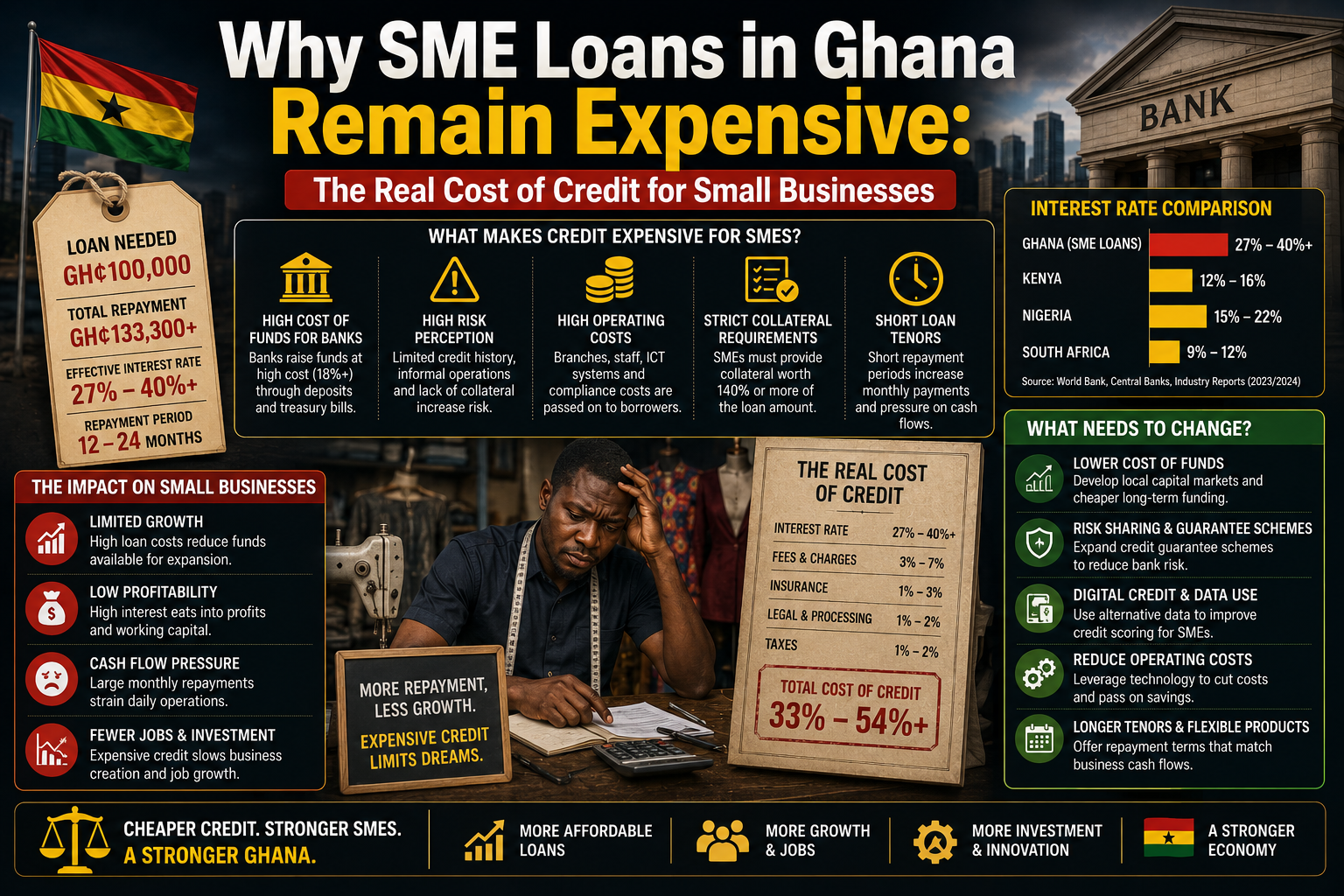
Average lending rates have fallen to 19.2%, yet SMEs still face a US$4.8bn financing gap. Our deep-dive analysis reveals six structural reasons SME loans in Ghana remain expensive — from collateral barriers to NPL risks.
Executive Introduction
The numbers are moving in the right direction — just not for the people who need it most.
Between February 2025 and February 2026, the average commercial bank lending rate in Ghana fell from 30.12 per cent to 19.2 per cent — a decline of nearly 11 percentage points. The Ghana Reference Rate, the benchmark that guides how banks price loans, plummeted from 23.99 per cent to 10.03 per cent over the same period. The Monetary Policy Rate now sits at 14 per cent, down from a crisis-era peak of 30 per cent. By any measure, Ghana’s cost of credit has improved dramatically.
📢 GET A DETAILED ARTICLES + JOBS
Join SamBoad's WhatsApp Channel and never miss a post or opportunity.
Yet walk into any market in Accra, Kumasi or Takoradi and ask a small business owner what interest rate they are paying. The answer will seldom be 19 per cent — and it will never be 10 per cent. Many SME borrowers still face effective rates above 25 per cent when factoring in fees, processing charges, mandatory savings requirements and insurance add-ons. Informal sector borrowers, who lack formal financial records, often pay even more through microfinance institutions or money lenders.
What explains this gap? The puzzle is not merely academic. Small and medium enterprises account for approximately 70 per cent of Ghana’s GDP and constitute over 90 per cent of registered businesses. They are the largest source of formal and informal employment. Yet only about half of Ghana’s SMEs have ever accessed bank credit, and fewer than a quarter of those loans extend beyond three years. The annual SME financing gap is estimated at approximately US$4.8 billion — one of the most severe on the African continent.
This profile goes inside the real cost of SME lending in Ghana. It explains why the transmission from falling policy rates to what an Accra-based tailor or Tamale-based agribusiness actually pays remains blocked by risk premiums, collateral requirements, legacy costs and deeper structural failures. It also examines what is beginning to change — from credit insurance schemes and digital lending platforms to expanded credit reporting — and what must change for Ghana’s SME engine to finally fire.
What Is an SME and Why Do They Matter?
Ghana’s National MSME Policy defines micro enterprises as those with fewer than five employees and less than GH¢10,000 in annual turnover; small enterprises as those with 6–29 employees and annual turnover of GH¢10,000 to GH¢500,000; and medium enterprises as those with 30–99 employees and turnover of GH¢500,000 to GH¢5 million. The definitions vary by institution, but the economic weight is undeniable.
SMEs account for more than 70 per cent of Ghana’s GDP and provide 80–90 per cent of total employment. They make up approximately 92 per cent of registered businesses and contribute 85 per cent of manufacturing jobs. They are the primary source of livelihoods for millions of Ghanaians, from market traders to transport operators to agro-processors.
Yet despite this outsized role, SMEs receive a disproportionately small share of formal credit. Private sector credit as a share of GDP is about 8 per cent in Ghana, compared with around 30 per cent in Kenya. Total bank loans and advances stood at approximately GH¢108.2 billion in February 2026, but the vast majority flows to large corporations, government-related entities and individuals with documented income and collateral. SMEs are credit-constrained, with each firm facing an average financing gap of GH¢208,545.
This mismatch between economic contribution and credit access is the central tension of Ghana’s SME lending story.
How the Cost of an SME Loan Is Calculated
To understand why SME loans remain expensive, one must first understand how banks actually price them. The interest rate a small business pays is not a single number but a layered calculation:
Base Rate (Ghana Reference Rate) – As of May 2026, the GRR stands at 10.03 per cent. This is the benchmark cost of funds for banks, influenced by the Bank of Ghana’s policy rate and interbank lending conditions.
Risk Premium – Banks add a spread above the GRR to compensate for the perceived risk of lending to an SME. For large, well-documented corporate borrowers, this spread might be 200–300 basis points. For a small business with limited financial records, no audited accounts and no prior borrowing history, the spread can be 800–1,200 basis points — or more.
Collateral Coverage Requirement – Banks typically require collateral coverage of at least 120 per cent of the loan value. This means a GH¢100,000 loan requires GH¢120,000 in pledged assets. The cost of valuing, documenting and insuring that collateral is passed to the borrower.
Processing and Administrative Fees – Upfront fees for loan application, credit assessment, legal documentation and monitoring add real costs. The Ghana National Chamber of Commerce and Industry has noted that non-interest cost components add an estimated four to five percentage points to the policy rate.
Mandatory Savings and Cross-Selling – Many banks require SME borrowers to maintain a savings account with a minimum balance or to purchase related products (insurance, for example). These are effectively additional costs of borrowing.
Effective vs. Nominal Rate – The advertised rate of 19.2 per cent is the nominal annual percentage rate. The effective rate — the actual cost after fees, savings requirements and other conditions — can be significantly higher.
The gap between the GRR (10.03 per cent) and the average lending rate (19.2 per cent) — roughly 900 basis points — represents the sum of these risk and operational layers. For SMEs, the effective spread is often even larger.
The Six Root Causes of Expensive SME Loans
Why does the gap persist, and why is it particularly wide for small businesses? Six interconnected factors explain the structural expensiveness of SME credit.
1. The Transmission Block: Falling Policy Rates, But Sticky Bank Margins
The Bank of Ghana has cut the Monetary Policy Rate aggressively — from 30 per cent in late 2023 to 14 per cent by March 2026, holding steady at the May 2026 MPC meeting. Governor Asiama has stated that the central bank is “focused on engineering a low interest rate regime.
Yet commercial banks have been slower to pass through these reductions. The Governor explained at the May 2026 MPC briefing that the current low-interest-rate regime remains relatively new to banks, forcing them to gradually adjust their portfolios and lending strategies. He also noted that banks are acting cautiously to avoid excessive credit risks, but lending rates are expected to adjust downward once the low-interest-rate environment is sustained.
The Ghana Association of Banks has maintained that the spread between the GRR and lending rates reflects genuine costs: provisions for non-performing loans, operating expenses and required returns on equity. The GNCCI has called on commercial banks to reduce non-interest charges, which it says add an estimated four to five percentage points to the policy rate.
2. Elevated NPLs and the Risk Premium Dilemma
Ghana’s banking sector is still digesting the aftermath of the economic crisis and the Domestic Debt Exchange Programme (DDEP). The non-performing loan ratio — loans not being repaid on time — fell to 18.4 per cent in February 2026, down from 22.6 per cent a year earlier. This represents genuine improvement in asset quality.
But 18.4 per cent is still more than triple the international benchmark of 5 per cent and among the highest in Sub-Saharan Africa. Governor Asiama has set a target of reducing NPLs to 10 per cent by the end of 2026, supported by a “clear roadmap” including enhanced supervision, stricter loan classification and provisioning requirements, and improved credit information sharing.
For banks, high NPLs in the SME portfolio create a vicious cycle. Losses from past defaults make lenders more cautious about future SME lending. To compensate for expected losses, they charge higher risk premiums. Those higher premiums make loans less affordable, which can increase default risk — completing the circle.
Fitch Solutions noted that while Ghanaian banks will benefit from the end of the DDEP and restored capital buffers, the high NPL rate will constrain profitability going forward. Banks cannot afford to lower SME rates significantly until they are confident that new lending will not produce fresh defaults.
3. Collateral: The Impossible Barrier
For most Ghanaian SMEs, the single largest obstacle to affordable credit is collateral. The Second Deputy Governor of the Bank of Ghana, Matilda Asante-Asiedu, noted that Ghana’s credit market has struggled with structural constraints including information gaps, narrow collateral options and weak enforcement systems — all of which have made lenders cautious and raised borrowing costs.
Traditional banks require landed property or high-value assets that most SMEs — particularly those led by women, youth and rural entrepreneurs — simply do not possess. In some cases, collateral coverage of at least 120 per cent is required, a stipulation driven by regulatory provisions rather than bank discretion. This over-collateralisation locks out the vast majority of small businesses.
The scale of the problem is staggering. The 24-Hour Economy Authority estimates that about 95 per cent of businesses struggle to access loans because they cannot provide the collateral demanded by lending institutions.
To its credit, the Bank of Ghana has expanded the Collateral Registry, which has recorded over 1.92 million secured transactions between 2010 and 2025, with an average of about 9,000 security interests registered weekly. But registration is not possession. An SME owner cannot pledge an asset they do not own.
4. Information Asymmetry: The Invisible SME
Banks struggle to assess the creditworthiness of SMEs because these businesses often lack formal financial records, audited accounts, tax histories or credit bureau data. Economists call this “information asymmetry”: the business owner knows their repayment capacity, but the bank cannot verify it reliably.
This knowledge gap leads to adverse selection — the phenomenon where banks, unable to distinguish good borrowers from bad, raise rates for everyone. The result is credit rationing: good SMEs are denied credit or offered expensive terms because the bank cannot be sure they are good.
Research on lending methodologies used by Ghanaian banks emphasises that the perceived problem of asymmetric information is a primary barrier to SME lending. In response, banks have historically defaulted to collateral-based lending — requiring assets they can seize if the borrower defaults — rather than cash-flow-based lending, which requires deeper underwriting capabilities.
The Bank of Ghana is moving to address this gap. In March 2026, it expanded the Credit Reporting System to include mobile money operators, FinTechs, retailers, utilities and government agencies providing credit to MSMEs. This expansion is designed to enable lenders to share and access data on borrowers’ repayment behaviour, reducing information asymmetry over time.
5. The Structural Hangover: DDEP and Bank Balance Sheets
The Domestic Debt Exchange Programme (DDEP) of 2023 restructured Ghana’s domestic debt, imposing losses on bondholders — including the banks. The restructured bonds have longer maturities and lower coupon rates, reducing banks’ interest income and constraining their liquidity positions.
This balance sheet weakness has made banks less willing and less able to extend patient, affordable credit to SMEs. With capital buffers only recently restored, banks have prioritised low-risk lending — particularly to the government and large corporations — over the higher-risk, higher-margin SME segment.
The post-DDEP adjustment has been described as a prolonged process, with the banking sector recording only a modest recovery in credit expansion. Banks that survived the crisis are now operating with greater caution, and that caution is most visible in their SME lending terms.
6. Bank Risk Aversion and the Preference for Large Borrowers
Even before the crisis, Ghanaian banks preferred lending to large, established corporations. The 2022–2025 crisis has only deepened this preference. Banks have been described as “wary of lending to smaller borrowers who lack collateral or credit histories, pricing risk heavily into SME loans” to the point that formal credit became essentially inaccessible for many during the peak of the crisis.
This risk aversion manifests in several ways. First, SME loans are typically shorter-term — rarely exceeding three years — while the working capital needs of many small businesses require longer amortisation schedules. Second, approval times can be extraordinarily long: the GNCCI has noted that credit approval periods sometimes range from 15 to 18 months, alongside delays associated with risk assessment processes and evolving documentation requirements. Third, the rejection rate for SME applications remains high, particularly in manufacturing and value-added sectors.
Governor Asiama has challenged banks directly on this front, noting that financing remains the “oxygen of enterprise” and calling on banks to explore alternatives such as cash-flow lending, purchase-order financing and supply-chain finance — models that have proven successful in Asia and Latin America. He has also observed that banks are not always the first port of call when firms need long-term financing, pointing to a structural gap in Ghana’s financial architecture.
The Real Economy Impact: What Expensive Credit Does to SMEs
The consequences of expensive SME loans are not abstract. They shape the daily reality of millions of Ghanaian business owners.
Constrained Growth and the Financing Gap: With only about half of SMEs ever accessing bank credit, the majority operate below their potential. The estimated US$4.8 billion annual financing gap represents lost output, lost jobs and lost tax revenue. Businesses that could scale remain small. Businesses that could formalise stay informal.
Short-Term Borrowing for Long-Term Needs: Because affordable long-term credit is scarce, many SMEs rely on short-term working capital loans — often at higher rates — to fund equipment purchases or expansion. This mismatch between borrowing term and investment horizon is inefficient and expensive.
High Mortality Rates: SMEs that fail cite access to finance as a primary cause. When credit is too expensive or unavailable, businesses cannot manage cash flow shocks, cannot rebuild after disruptions, and cannot compete with larger rivals who enjoy cheaper capital.
Informal Financing Dominance: The high cost and limited availability of formal bank credit push SMEs toward informal sources — money lenders, rotating savings groups, family and friends. These sources offer convenience and flexibility but often at much higher effective interest rates and with limited consumer protection.
The Gender Gap: Women-owned SMEs face even steeper barriers. Women’s access to formal credit remains particularly constrained. About 92 per cent of women are engaged in the informal sector. Women-owned businesses are less likely to own titled land — the preferred collateral — and are often excluded from formal credit markets. Stanbic Bank launched Obaa Sima in March 2026, a women-focused banking proposition aimed at expanding access to finance for women, particularly those in the informal sector. The government has also allocated GH¢401 million to capitalise the Women’s Development Bank to enable affordable lending to women-owned businesses.
Informality and Fragmentation: The fragmentation of Ghana’s SME financing ecosystem is another structural barrier. The microfinance sector’s share of banking assets has dropped to 8 per cent, reflecting a loss of competitiveness compared to commercial banks. For many SMEs, microfinance institutions are the only formal credit option, but consolidation and regulatory pressures are reducing their reach and increasing their caution.
Pockets of Change: Where the Lending Landscape Is Shifting
While the structural barriers to affordable SME credit are deep, change is happening — slowly, unevenly and often outside the traditional banking system.
Digital Lending and Fintech: Fintech platforms are beginning to fill the gap that traditional banks have left open. Fido Ghana secured US2.3 million) in loans to around 1,500 MSMEs through Oze’s digital lending platform. These platforms use transaction data, mobile money history and alternative credit scoring to assess risk — bypassing the collateral requirement that blocks most SMEs.
Non-Interest Banking: Ghana is edging closer to launching non-interest (Islamic) banking, with at least one indigenous lender formally applying for a licence. Analysts say Ghana’s entry into non-interest banking could ease credit constraints, particularly for SMEs, which often face high borrowing costs under conventional lending models.
Credit Insurance and Guarantee Schemes: The 24-Hour Economy Authority is collaborating with the Bank of Ghana and the National Insurance Commission to develop a credit insurance guarantee scheme aimed at improving access to finance for businesses. The scheme would allow loans advanced to SMEs to be insured, removing the need for lenders to rely primarily on physical assets as security. This has the potential to be genuinely transformative — if implemented effectively.
Digital Trade Finance: Ghana’s estimated annual trade finance gap is about US$7 billion. Neofingo, a new Digital Trade Finance Corridor launched in March 2026, is designed to close this gap by connecting Ghanaian SME exporters with the international trade finance system, including the Ghanaian diaspora.
Expanded Credit Reporting: The Bank of Ghana’s expansion of the Credit Reporting System to include mobile money operators, FinTechs, retailers and utilities is a foundational reform. Over time, as more data flows into the credit bureaus (XDS Data Ghana, Dun & Bradstreet Credit Bureau, My Credit Score), banks will be better able to assess SME creditworthiness without defaulting to collateral-based lending.
Government and Development Programmes: The Development Bank of Ghana and Exim Bank have committed GH¢1.9 billion to SME development. DBG is rolling out GH¢500 million specifically to support SMEs in the agriculture value chain. The 24-Hour Economy and Accelerated Export Development Programme is offering startup loans ranging from GH¢5,000 to GH¢500,000 to young Ghanaians aged 18–35.
MTN’s SME Accelerate: MTN Ghana launched its SME Accelerate 2026 initiative, a year-long programme aimed at helping small businesses formalise operations, access markets and build the documentation required to qualify for financing. This kind of technical assistance — separate from lending — is critical for moving SMEs from informality to bankability.
Challenges and Risks to the Lending Outlook
Despite pockets of progress, the outlook for SME lending remains constrained.
NPLs remain elevated: Even at 18.4 per cent, the NPL ratio is a major drag on bank willingness to lend to SMEs. The BoG’s roadmap to 10 per cent by end-2026 is ambitious. Achieving it will require aggressive write-offs, stronger economic growth and significantly better underwriting.
The collateral culture persists: For all the talk of alternative lending models, most banks still default to collateral-based lending. Changing institutional lending culture takes years, not months.
Macroeconomic vulnerability: The BoG held the policy rate at 14 per cent in May 2026 amid rising external inflation risks linked to Middle East tensions. If the cedi weakens further or inflation resurges, the easing cycle could reverse — pushing SME rates higher again.
Fintechs are not a panacea: Digital lending platforms offer convenience but often at high effective interest rates. Their small-ticket, short-term lending models do not solve the need for larger, longer-term growth capital.
Transmission remains weak: Governor Asiama has expressed concern about weak private-sector lending relative to other African economies. The fact that banks are not consistently passing through policy rate cuts suggests structural problems that will not be solved by macro policy alone.
Informal sector credit is still not measured: The Bank of Ghana has acknowledged that credit conditions for the informal sector remain difficult to measure. Traders in major markets continue to report that lower rates have not reached them.
Future Outlook: Will SME Credit Ever Become Affordable?
Three scenarios for the trajectory of SME lending costs in Ghana:
Scenario One: Gradual Improvement (65 per cent probability)
In this base case, average lending rates continue to fall toward 16–17 per cent by end-2026 and 14–15 per cent by end-2027. The credit insurance scheme is implemented in 2027, reducing collateral barriers. Expanded credit reporting gradually reduces information asymmetry. SME credit grows at 15–20 per cent annually. This scenario assumes continued fiscal discipline, stable cedi and no major external shocks.
Scenario Two: Breakthrough (20 per cent probability)
If the digital lending ecosystem scales rapidly and the credit insurance scheme succeeds, SME access could expand significantly. Lending rates could fall into the low teens for well-documented SMEs. The annual financing gap could begin to close. This scenario requires aggressive implementation of reforms and strong private sector response.
Scenario Three: Reversal (15 per cent probability)
If global oil prices surge due to Middle East tensions, the cedi weakens past 15 per cent depreciation, or inflation returns toward 8–10 per cent, the BoG may be forced to raise rates. In this case, SME lending rates would rise again — undoing much of the progress of the past 18 months and pushing the SME financing gap even wider.
The most likely path is Scenario One: slow, incremental improvement, not a transformation. The structural barriers to affordable SME credit — collateral, information asymmetry, bank risk aversion, high NPLs — are deeply embedded. They will not be solved in one budget cycle or one MPC meeting.
But the direction of travel is clear. The Bank of Ghana is serious about creating a low-interest-rate environment. Reforms to credit reporting, collateral registration and credit insurance are moving in the right direction. Fintechs are demonstrating that SME lending can be profitable at scale. The question is not whether SME credit will become more affordable — it is how fast, and how many businesses will be left behind in the meantime.
THSB Conclusion
Why do SME loans in Ghana remain expensive? The answer is not that Ghana’s banks are greedy or that its central bank is incompetent. The answer is structural, layered and stubborn.
Expensive SME credit is the product of high policy rates (though falling), weak transmission (though improving), elevated NPLs (though declining), crippling collateral requirements (though being addressed), severe information asymmetries (though being reduced with credit reporting), and deep-seated bank risk aversion (though being challenged by competition from fintechs).
The average SME borrower today pays about 19.2 per cent — a dramatic improvement from the 30+ per cent rates of 2023 and 2024. But that average conceals wide variation: the well-documented, collateral-owning, formally registered SME pays less; the market trader, the rural agro-processor, the youth-led startup pays more — if they can access credit at all.
Ghana’s SME economy is too important to be starved of affordable credit. SMEs are 70 per cent of GDP and over 90 per cent of employment. The US$4.8 billion annual financing gap is not just a statistic — it is thousands of businesses that cannot expand, millions of jobs that are not created, and billions in economic output that is never realised.
The policy direction is right. Rates are falling. Reforms are underway. But the gap between the central bank’s policy rate and what a small business actually pays remains too wide. Closing that gap — not with one reform but with many, not quickly but steadily — is one of the most important economic challenges Ghana faces. The engine of the Ghanaian economy is idling. Affordable credit is the fuel it needs to run.
Frequently Asked Questions (FAQ)
Q1: What is the current average SME loan interest rate in Ghana?
The average commercial bank lending rate in Ghana is approximately 19.2 per cent as of February 2026, down from 30.12 per cent a year earlier. However, SME borrowers often face effective rates above 25 per cent when factoring in fees, processing charges, mandatory savings and insurance.
Q2: Why haven’t SME lending rates fallen as much as the Bank of Ghana’s policy rate?
The Monetary Policy Rate (MPR) is the rate at which the central bank lends to commercial banks — not the rate at which banks lend to SME customers. The gap between the Ghana Reference Rate (10.03 per cent) and actual lending rates (19.2 per cent) reflects risk premiums, operational costs, non-performing loan provisions and required returns on equity.
Q3: What is the biggest barrier for an SME trying to get a bank loan in Ghana?
Collateral. Approximately 95 per cent of businesses struggle to access loans because they cannot provide the collateral demanded by lending institutions. Traditional banks typically require landed property or high-value assets, which most SMEs — particularly women-owned, youth-led and rural businesses — do not possess.
Q4: How does the Domestic Debt Exchange Programme (DDEP) affect SME lending?
The DDEP restructured Ghana’s domestic debt, imposing losses on banks and extending bond maturities at lower rates. This reduced banks’ interest income and constrained their liquidity positions, making them more cautious and less willing to extend affordable, patient credit to SME borrowers.
Q5: What is the non-performing loan (NPL) ratio in Ghana, and why does it matter for SMEs?
The NPL ratio stands at 18.4 per cent as of February 2026, down from 22.6 per cent a year earlier. It remains more than triple the international benchmark of 5 per cent. High NPLs make banks risk-averse, leading them to charge higher risk premiums on SME loans to compensate for expected losses.
Q6: Are there any government programmes helping SMEs access cheaper credit?
Yes. The Development Bank of Ghana and Exim Bank have committed GH¢1.9 billion to SME development. DBG is rolling out GH¢500 million specifically for SMEs in agriculture. A credit insurance guarantee scheme is being developed to reduce reliance on physical collateral. The 24-Hour Economy Programme offers startup loans from GH¢5,000 to GH¢500,000 to young Ghanaians aged 18–35. The Women’s Development Bank has been allocated GH¢401 million to capitalise affordable lending to women-owned businesses.
Q7: What are fintechs doing to improve SME access to credit?
Fintech platforms are using transaction data, mobile money history and alternative credit scoring to assess risk without requiring traditional collateral. Fido Ghana raised US$5.5 million to expand digital lending. Adehyeman plans to provide GH¢30 million in loans to 1,500 MSMEs through Oze’s digital platform.
Q8: How is the Bank of Ghana improving SME credit assessment?
The BoG has expanded the Credit Reporting System to include mobile money operators, FinTechs, retailers, utilities and government agencies providing credit to MSMEs. This enables lenders to share and access data on borrowers’ repayment behaviour, gradually reducing information asymmetry that currently makes banks default to collateral-based lending.
Q9: How much of Ghana’s GDP do SMEs contribute?
SMEs contribute approximately 70 per cent of Ghana’s GDP, constitute 92 per cent of registered businesses, and provide 80–90 per cent of total employment.
Q10: What is the estimated SME financing gap in Ghana?
Ghana faces an estimated annual SME financing gap of approximately US$4.8 billion — one of the most severe on the African continent. Approximately 50 per cent of MSMEs remain credit-constrained, with each firm facing an average financing gap of GH¢208,545.
Q11: Will SME lending rates continue to fall in 2026 and 2027?
Most analysts expect average lending rates to fall gradually toward 16–17 per cent by end-2026 and 14–15 per cent by end-2027, assuming continued fiscal discipline, a stable cedi and no major external shocks. However, significant structural barriers — collateral, information asymmetry, bank risk aversion — will remain.
Q12: What can an SME do today to improve its chances of getting an affordable loan?
Formalise your business registration, maintain separate business bank accounts, keep detailed financial records, build a credit history with a credit bureau, explore digital lending platforms that use alternative data, consider microfinance institutions if banks are inaccessible, and watch for credit insurance scheme developments that may reduce collateral requirements.
Source: The High Street Business
Disclaimer: Some content on The High Street Business may be aggregated, summarized, or edited from third-party sources for informational purposes. Images and media are used under fair use or royalty-free licenses. The High Street Business is a subsidiary of SamBoad Publishing under SamBoad Business Group Ltd, registered in Ghana since 2014.
For concerns or inquiries, please visit our Privacy Policy or Contact Page.

Esther Aku-Sika is a content writer and social media strategist who helps brands and startups grow through intentional storytelling and practical marketing strategies. With a keen eye for trends and audience behavior, she shares business insights, content strategies, and real-life lessons to help entrepreneurs build visibility and turn ideas into income. Through her writing, she simplifies complex concepts and equips readers with actionable steps to grow in today’s digital space.