









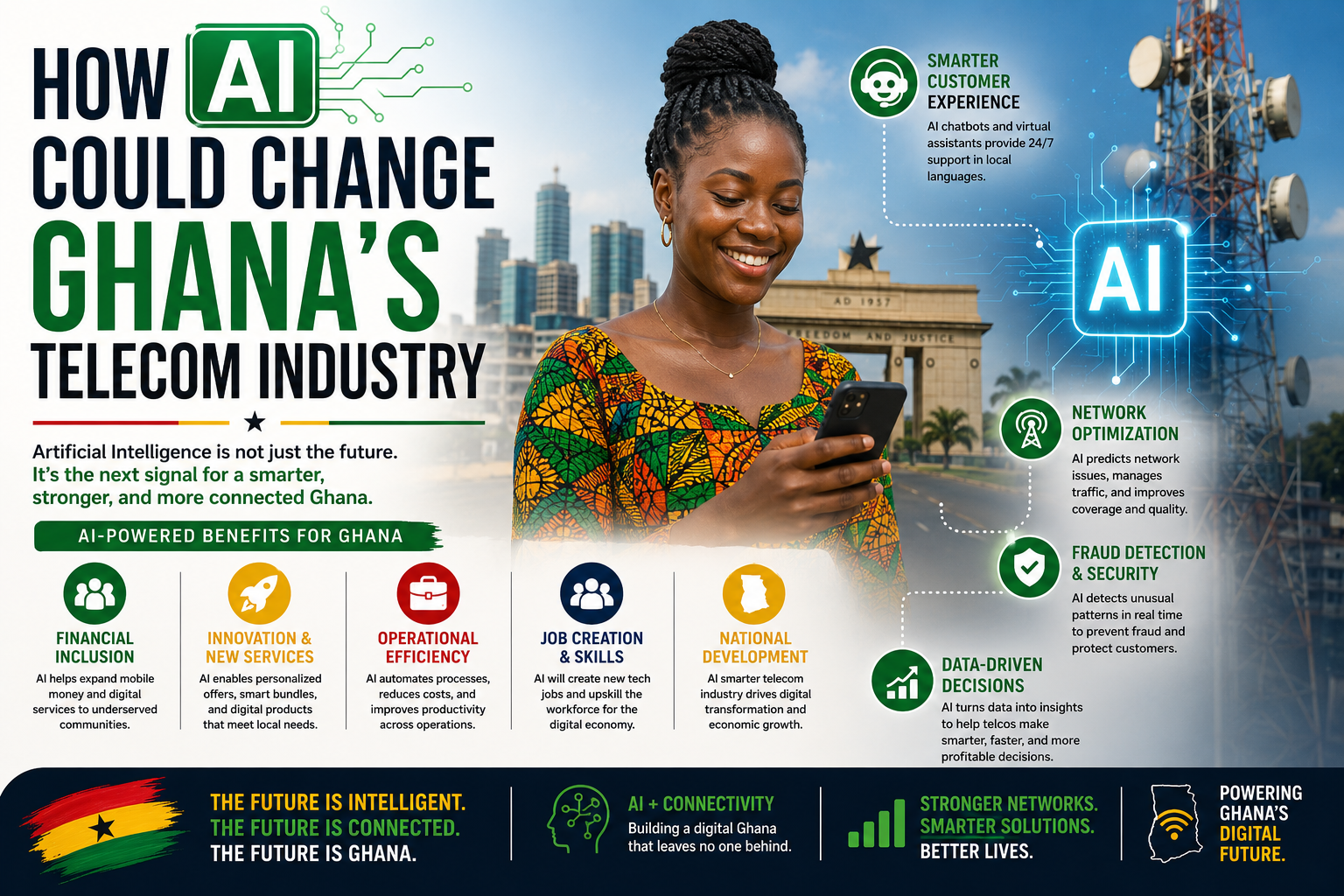

How AI Could Change Ghana’s Telecom Industry — MTN’s AI‑powered Alpha Antenna has delivered a 97% reduction in network maintenance costs. Ghana’s National AI Strategy is live. The BoG now governs AI in fraud detection. Our deep‑dive analysis reveals how artificial intelligence is transforming connectivity, customer experience, and mobile money security.
Executive Introduction
The telecom industry in Ghana is on the cusp of its most profound transformation since the launch of mobile money. Artificial intelligence is no longer a distant promise or a Silicon Valley abstraction. It is being deployed today — in the antenna arrays that beam connectivity across Accra, in the algorithms that block fraudulent Mobile Money messages before they reach your phone, and in the data centres that MTN is racing to build as it pours $1.1 billion into the country over the next three years.
The numbers are already visible. MTN Ghana’s customer value management algorithms helped drive a 5.2 per cent increase in its subscriber base and a 39.6 per cent rise in service revenue in the first quarter of 2025 alone. Telecel Ghana has incorporated AI to create personalised data and voice packages for customers across all socio‑economic levels. The Bank of Ghana has issued new governance standards for AI systems used in fraud detection and credit scoring, as financial institutions increasingly adopt machine learning for everything from loan approvals to customer service. And the government has unveiled a National AI Strategy — a decade‑long blueprint approved by Cabinet — that explicitly positions telecom infrastructure as the backbone of Ghana’s ambition to become West Africa’s AI hub by 2033.
📢 GET DETAILED ARTICLES + JOBS
Join THSB's WhatsApp Channel and never miss a post or opportunity.
This profile examines how AI is changing Ghana’s telecom industry across five critical dimensions: network operations and cost efficiency, customer experience and personalisation, fraud detection and security, the looming talent gap, and the regulatory framework that will determine whether AI serves Ghanaians or simply serves the companies that deploy it. The technology is being rolled out at speed. The question is whether the benefits will be distributed as widely as the signals.

The National AI Strategy — The Policy Backbone
Ghana’s official National AI Strategy, developed with support from Smart Africa and German development agency GIZ FAIR Forward, was launched on 24 April 2026, with President John Dramani Mahama presiding over the unveiling. The decade‑long blueprint (2023‑2033) is built around eight pillars covering AI education, youth employment, digital infrastructure, data governance, ecosystem development, sectoral AI adoption, applied research, and public sector deployment, with seven priority sectors identified including healthcare, agriculture, financial services, and energy.
The strategy positions telecom infrastructure as foundational to all other AI ambitions. Mobile penetration in Ghana currently exceeds 110 per cent, with over 38 million mobile subscriptions nationwide — a scale that the Communications Minister has cited as central to scaling AI‑driven services across the country. A dedicated Responsible AI Office will oversee implementation, ensuring the strategy aligns with ethical standards and national development goals.
The government has also established a $1 billion AI and innovation hub partnership with the United Arab Emirates, alongside MTN’s parallel $1.1 billion investment, bringing total committed funding to more than $2 billion aimed at turning Ghana into a serious technology hub. The Ministry of Communications, Digital Technology and Innovations has identified four priority implementation areas: strengthening data governance systems, investing in AI research and computing infrastructure, expanding AI education and digital skills, and embedding ethical safeguards in deployment. For the telecom industry, this policy framework provides both direction and pressure: operators are expected to align their AI investments with national ambitions, and they are being watched closely by a regulator that has made clear its intention to hold dominant players accountable.
AI‑Powered Network Optimisation — The Alpha Antenna and the 30x Efficiency Leap
The most tangible evidence of AI’s transformative potential in Ghana’s telecom industry is the Alpha Antenna — a collaboration between MTN Ghana and Huawei that represents the world’s first large‑scale deployment of AI‑powered intelligent antenna technology.
Traditional cell tower antennas are static. They point in fixed directions with fixed settings until a technician physically climbs the tower to adjust them — a process that could take weeks to complete across an entire network. The Alpha Antenna fundamentally changes this equation. It contains built‑in sensors and intelligence that allow it to monitor itself and adjust its settings automatically based on real‑time network conditions. The solution’s Antenna Information Sensor Unit continuously monitors performance metrics, signal quality, and network load, while the Array Information Mapping Unit functions as the processing brain, analysing data from the sensors and automatically adjusting the antenna’s beam patterns, direction, and power levels.
The results are striking. Post‑deployment tests recorded a rise in regional traffic by 6.8 per cent, while operations and maintenance efficiency improved by a factor of 30x. Optimisation costs dropped dramatically because no one needs to visit towers or manually adjust settings — a 97 per cent reduction in labour costs for network maintenance. The network can now dynamically adapt coverage and capacity to real‑time demand, collapsing optimisation cycles from weeks to minutes while delivering a consistently superior user experience.
For a country where diesel‑dependent towers and frequent fibre cuts already impose significant cost burdens on operators, the efficiency gains from AI‑powered network management are not merely incremental — they are structural. MTN Ghana describes the Alpha Antenna solution as a pivotal step toward the full digital transformation of network infrastructure, empowering the network with real‑time retrieval and rapid‑response capabilities.
Beyond antenna technology, AI is also being deployed for predictive maintenance. Telecel Ghana’s CEO, Patricia Obo‑Nai, speaking at the 2025 World Economic Forum in Davos, explained that AI can predict when maintenance is due, predict hardware failures and reduce service disruptions, meaning less operational challenges, less movement of engineers across sites, and efficient energy management. She added that AI can help determine locations where solar systems can be deployed as operators move toward more renewable energy sources. For an industry where diesel accounts for 30‑60 per cent of a tower’s operational costs in remote areas, these efficiency gains directly translate into lower cost bases — and, potentially, into more affordable data for consumers.
Customer Experience and Personalisation — Beyond the Generic Bundle Menu
The bundle menu that appears on every Ghanaian mobile phone is slowly being transformed from a one‑size‑fits‑all list into a personalised interface shaped by machine learning.
MTN Ghana has been the early leader in this area. The company’s customer value management initiatives — powered by AI — assisted the telco in improving user experience across its service offerings, contributing to a 5.2 per cent increase in its subscriber base and a 39.6 per cent rise in service revenue in Q1 2025. The company was the first to use mobile money chatbots with AI capabilities to address complaints, customer inquiries, and payments through various social media platforms, including Facebook Messenger and WhatsApp, and via SMS.

Telecel Ghana has also embedded AI into its product design system to create tailored data and voice packages for customers, regardless of their socio‑economic status, furthering inclusivity. The strategy is straightforward: rather than forcing customers to choose from a rigid bundle menu, AI algorithms analyse usage patterns — when and where customers use data, which applications they prefer, how much they are willing to spend — and then generate personalised package recommendations.
Ghana Commercial Bank introduced an AI‑driven chatbot that provides customers with a conversational interface to perform transactions, including balance inquiries, transfers, and bill payments. The fintech PayBox launched Buddy, an AI‑powered decentralised app offering 24‑7 customer support and real‑time transaction monitoring. And Abena AI, a Ghanaian voice‑first assistant, allows users to check airtime and mobile money balances across all networks without an internet connection.
The economic logic is clear. Personalisation increases engagement, which increases data consumption, which increases revenue. A customer who receives a WhatsApp notification offering a customised data bundle for their specific usage pattern is far more likely to purchase than one who must scroll through a static bundle menu. Over time, AI‑driven personalisation could reduce the regressive nature of the current bundle menu, where the poorest consumers pay the highest effective per‑gigabyte rates. But that outcome depends on whether operators choose to use their AI capabilities to optimise for inclusion or solely for profit.
Fraud Detection and Security — The AI Shield for Mobile Money
The most urgent application of AI in Ghana’s telecom ecosystem is not about efficiency or personalisation. It is about security.
Mobile money fraud has been a persistent threat to the entire digital finance ecosystem. Cyber fraud losses rose from GH¢2.4 million in the first quarter of 2024 to GH¢14.94 million in the first half of 2025. Fraudsters have become increasingly sophisticated, using SIM swaps, phishing attacks, and fake customer service numbers to drain accounts. The traditional approach to fraud detection — rule‑based systems that flag transactions matching certain pre‑defined patterns — proved insufficient against these evolving tactics.
MTN has deployed artificial intelligence and machine learning technologies to detect and block fraudulent Mobile Money messages before they reach customers. According to MTN’s Senior Manager for Fintech, Abdul‑Majeed Rufai, the system uses advanced algorithms to identify attempts to mimic official transaction alerts, even when fraudsters manipulate message formats or introduce spelling errors. The AI‑driven solution enables real‑time detection of suspicious patterns, allowing MTN to act swiftly to prevent financial losses.
The shift has been from static rules to behavioural analysis. Shaibu Haruna, CEO of MobileMoney Fintech Limited, explained that the organisation is placing greater emphasis on technology to detect unusual transaction activity and uncover patterns commonly associated with fraudulent agents. “Thanks to the power of artificial intelligence, we are strengthening our monitoring mechanisms, shifting from just rule‑based applications to more behavioral analysis, which makes it a lot easier for us to narrow down the elements and deal with them,” he said.
This approach works by establishing a baseline of normal transaction behaviour for each user — their typical transaction size, frequency, time of day, geographic location — and then flagging deviations from that baseline. A sudden large transfer to a new recipient, a login from an unfamiliar device, or a rapid sequence of transactions that matches known fraud patterns all trigger real‑time alerts.
The Bank of Ghana has formalised this shift. The revised Cyber and Information Security Directive (CISD 2026) introduces new governance standards for artificial intelligence and machine learning systems used in fraud detection and credit scoring, aimed at ensuring transparency and security in automated decision‑making. The directive extends regulatory coverage beyond banks to include fintechs, microfinance institutions, and other financial sector players, recognising that the digital financial ecosystem is only as secure as its weakest link. Governor Dr Johnson Pandit Asiama described cyber threats as “national security concerns”, citing risks such as ransomware attacks and systemic data breaches that can disrupt operations and erode public confidence.
The directive also sets stricter conditions for cloud adoption, limiting the hosting of sensitive financial data outside Ghana in line with data sovereignty requirements under existing legislation. A proportionality framework scales compliance requirements based on the size and risk profile of institutions, alongside a new mandate requiring at least one board member to have verifiable expertise in cyber risk management. For fraud detection, the message is unambiguous: AI is not optional. It is the new baseline.
The Talent Gap — Can Ghana Train the AI Workforce It Needs?
The most significant constraint on AI adoption in Ghana’s telecom industry is not technological. It is human.
Building and maintaining AI systems requires data scientists, machine learning engineers, and cloud infrastructure specialists — roles that are in short supply globally and even scarcer in Ghana. The government’s response is the “One Million Coders” programme, a flagship initiative designed to equip Ghana’s youth with critical digital skills. MTN has committed $2 million directly to the programme, a contribution that “directly operationalises Pillar 2 of the National AI Strategy: ‘Empower Youth for AI Jobs of the Future,'” according to a statement from the company. “By training youth in coding and digital literacy, MTN is helping to build the ‘pool of talent’ necessary to sustain a local AI ecosystem”.
Telecel has also reinforced its commitment to digital skills development by partnering with the Ghana One Million Coders initiative, offering free access to its Startocode platform for 100,000 young people. The company has hosted three‑day AI workshops for small business owners, part of its SME Month celebrations, providing practical training in artificial intelligence for business growth.
The scale of the ambition is matched by the scale of the investment. The government is building a $250 million computing centre — a facility designed to provide the raw processing power that AI applications require. The MTN building, donated to the government, will become one of the centres of excellence for artificial intelligence and software development. The Pan African AI Summit (PAAIS) 2026, returning to Ghana for the second time, will serve as a forum for advancing the principles of the National AI Strategy.
Yet the gap between ambition and execution remains wide. Ghana currently ranks 72nd globally and 6th in Africa in the Global AI Index 2025, behind Egypt, Mauritius, South Africa, and Tunisia. The ranking reflects balanced development across talent, research, infrastructure, and a growing startup ecosystem — but it also indicates that Ghana is not yet at the front of the continental pack. Without a sustained pipeline of trained AI professionals, the telecom industry’s ability to deploy and maintain AI systems will be constrained by talent availability, not capital availability.
The Challenges — Data Costs, Connectivity, and the Risk of Entrenching Dominance
For all the promise of AI, the telecom industry in Ghana faces structural constraints that no algorithm can solve.
The first is data cost. For AI to function effectively, it requires massive amounts of data — data that must be transmitted across networks. Former Vice‑President Dr Mahamudu Bawumia has cautioned that the high cost of mobile data remains a major obstacle to Africa’s participation in the global AI revolution. If connectivity remains too expensive for the majority of Ghanaians, the data needed to train AI models will be concentrated among a small, affluent urban population, producing algorithms that are optimised for Accra’s Ridge neighbourhood but fail in rural villages.
The second is connectivity itself. AI applications require low latency and high bandwidth. 5G is the enabling infrastructure for real‑time AI use cases — autonomous systems, remote surgery, connected vehicles. Ghana’s 5G rollout, led by the Next‑Gen Infrastructure Company (NGIC), has faced delays, with the Communications Minister reporting that the network had fewer than 100 sites live by early 2026, despite an initial target of 350 sites by Q4 2025. The government has since revoked NGIC’s exclusivity clause, opening 5G spectrum to competitive bidding in an effort to accelerate deployment. But the gap between coverage targets and actual rollout remains significant.
The third challenge is the market structure itself. MTN Ghana controls more than 80 per cent of mobile data subscriptions. The company has both the capital and the incentive to invest heavily in AI — and it is doing so, with a $1.1 billion commitment over three years. Telecel, with less than 15 per cent market share, cannot match that scale. The risk is that AI will entrench, rather than challenge, MTN’s dominance. The Communications Minister, Samuel Nartey George, has explicitly stated that MTN’s market dominance comes with greater responsibility, particularly in improving service quality, pricing transparency, and network reliability. But whether regulatory oversight can keep pace with technological transformation remains to be seen.
Future Outlook — Three Scenarios for AI in Ghana’s Telecom Industry
Scenario One: Gradual Integration (65 per cent probability)
In this base case, AI adoption continues steadily but unevenly. MTN’s Alpha Antenna deployment expands to cover most urban centres, and predictive maintenance reduces operational costs, but Telecel struggles to match the pace of investment. AI‑powered personalisation improves customer retention, and fraud detection systems meaningfully reduce mobile money losses. The National AI Strategy produces a modest expansion of the talent pool, but skill shortages remain a binding constraint. Data costs fall slowly, but affordability for low‑income households remains a challenge. Ghana’s Global AI Index ranking rises to the top five in Africa, but the country does not achieve its ambition of becoming the continent’s AI hub by 2033.
Scenario Two: Accelerated Breakthrough (25 per cent probability)
The “Dig Once” fibre policy and the dedicated electricity tariff for telecoms are implemented effectively, significantly lowering the cost base for all operators. 5G rollout accelerates, reaching 50‑60 per cent population coverage by 2028. The One Million Coders programme produces a genuine pipeline of AI talent, and Ghana attracts significant foreign investment in AI research and development. MTN and Telecel compete on AI‑driven personalisation, driving prices down and improving service quality across the industry. Ghana’s AI ranking rises to the top three in Africa, and the telecom industry becomes a genuine engine of digital inclusion, not merely a utility.
Scenario Three: Stagnation and Entrenchment (10 per cent probability)
MTN’s market share continues to grow, approaching 85 per cent, while Telecel fails to integrate AT Ghana effectively and struggles to invest in AI capabilities. Data costs plateau, and affordability for low‑income households worsens as inflation erodes real incomes. The One Million Coders programme produces graduates but there are insufficient jobs to absorb them, leading to a skills drain. AI deployment is concentrated in high‑value urban markets, leaving rural Ghana further behind. Fraudsters adapt to AI detection systems faster than the industry can update them, and trust in mobile money declines. This scenario would be a significant setback for both the telecom industry and Ghana’s broader digital ambitions.
The most likely path is Scenario One: gradual integration, not a breakthrough. The technology is advancing rapidly, but the structural constraints — market concentration, infrastructure costs, and the talent gap — will limit the speed of transformation.
Conclusion
Artificial intelligence is not a distant future for Ghana’s telecom industry. It is being deployed today — in the antenna arrays that beam connectivity across Accra, in the algorithms that block fraudulent Mobile Money messages, and in the data centres that MTN is racing to build. The Alpha Antenna has already delivered a 30‑fold improvement in maintenance efficiency and a 97 per cent reduction in labour costs. Fraud detection systems are shifting from static rules to behavioural analysis, making it harder for fraudsters to evade detection. The National AI Strategy has set a clear direction, and the Bank of Ghana has established governance standards for AI in financial services.
Yet the promise of AI cannot be separated from the structure of the industry that deploys it. MTN’s $1.1 billion investment is transformative — but it is also an investment in entrenching a market position that already exceeds 80 per cent. Telecel’s AI initiatives are genuine, but they are operating from a distant second position. The One Million Coders programme is essential, but training coders without creating jobs for them is a recipe for frustration, not transformation.
The question is not whether AI will change Ghana’s telecom industry. It already has. The question is whether that change will be inclusive — whether the efficiency gains from AI will translate into lower data costs for the poorest consumers, whether the talent pipeline will produce opportunities for young Ghanaians across the country, and whether the algorithms that increasingly govern connectivity will serve the public interest or merely the private profit of a dominant operator.
The technology is ready. The capital is being deployed. The policy framework is in place. The missing ingredient is the will to ensure that the AI revolution in Ghana’s telecom industry lifts all Ghanaians, not just the ones who already have the fastest 5G connections. That is the unfinished business of the most important technological transformation the industry has ever seen. And it will not be solved by an algorithm. It will be solved by the choices that regulators, operators, and policymakers make — right now — about who gets to benefit from the intelligence embedded in the network.
Quick Facts Box
Category || Details
- Industry Telecommunications / Digital Financial Services
- MTN Ghana 3‑Year AI & Network Investment $1.1 billion
- MTN 2026 Investment $380 million
- MTN New Network Sites Planned (2026) ~800 (500 new sites target)
- Alpha Antenna Efficiency Gain 30x improvement in O&M efficiency
- Alpha Antenna Labour Cost Reduction 97%
- Alpha Antenna Traffic Increase 6.8% post‑deployment
- National AI Strategy Launch Date 24 April 2026
- National AI Strategy Period 2023‑2033
- Ghana Mobile Penetration Exceeds 110% (38m+ subscriptions)
- Ghana AI Index Rank (2025) 72nd globally, 6th in Africa
- Government AI & Innovation Hub (UAE Partnership) $1 billion
- Government AI Computing Centre $250 million
- One Million Coders MTN Contribution $2 million
- Telecel Startocode Platform Access 100,000 young people
- BoG AI Governance Directive CISD 2026
- Bank of Ghana AI Governance Areas Fraud detection, credit scoring, automated decisions
- Fraud Losses (H1 2025) GH¢14.94 million (up from GH¢2.4m in Q1 2024)
- 5G Coverage Target 70% population coverage by 2030+
- Key Regulators NCA, Ministry of Communications, Digital Technology and Innovations, Bank of Ghana
- Primary Telecom Operators MTN Ghana, Telecel Ghana (absorbing AT Ghana)
Frequently Asked Questions (FAQ)
Q1: What is the Alpha Antenna and why does it matter for Ghana’s telecom industry?
The Alpha Antenna, deployed by MTN Ghana in partnership with Huawei, is the world’s first large‑scale AI‑powered intelligent antenna. Unlike traditional antennas that require technicians to manually adjust settings — a process that could take weeks — the Alpha Antenna uses built‑in sensors and AI to monitor network conditions and adjust its beam patterns automatically in real time. The results include a 30x improvement in maintenance efficiency and a 97 per cent reduction in labour costs, while increasing regional traffic by 6.8 per cent.
Q2: How much is MTN Ghana investing in AI and network infrastructure?
MTN Ghana has announced a $1.1 billion investment over the next three years, with approximately $380 million to be deployed in 2026 alone. The investment focuses on expanding 4G and 5G coverage, building large‑scale data centres, improving customer experience, and supporting Ghana’s broader ambitions around AI and cloud computing.
Q3: What is the National AI Strategy and when was it launched?
Ghana’s National Artificial Intelligence Strategy is a decade‑long blueprint (2023‑2033) developed with support from Smart Africa and GIZ FAIR Forward. It was officially launched on 24 April 2026, with President John Dramani Mahama presiding over the unveiling. The strategy is built around eight pillars covering AI education, youth employment, digital infrastructure, data governance, and sectoral AI adoption across healthcare, agriculture, financial services, and other priority sectors.
Q4: How is the Bank of Ghana regulating AI in the telecom and financial sectors?
The Bank of Ghana introduced a revised Cyber and Information Security Directive (CISD 2026) in March 2026, which includes new governance standards for artificial intelligence and machine learning systems used in fraud detection and credit scoring. The directive aims to ensure transparency and security in automated decision‑making. It extends regulatory coverage beyond banks to include fintechs and payment service providers, limiting the hosting of sensitive financial data outside Ghana.
Q5: Is AI being used to fight Mobile Money fraud in Ghana?
Yes. MTN has deployed AI and machine learning technologies to detect and block fraudulent Mobile Money messages before they reach customers. The system uses advanced algorithms to identify attempts to mimic official transaction alerts, even when fraudsters manipulate message formats. MobileMoney Fintech Limited is also shifting from rule‑based fraud detection to behavioural analysis, using AI to detect unusual transaction activity and uncover patterns commonly associated with fraudulent agents.
Q6: How is Telecel Ghana using AI?
Telecel Ghana has incorporated AI to create personalised data and voice packages for customers, regardless of their socio‑economic status, furthering inclusivity. The company’s CEO has emphasised that AI can predict when maintenance is due, predict hardware failures, reduce service disruptions, and determine optimal locations for solar energy deployment. Telecel has also partnered with the One Million Coders initiative, offering free access to its Startocode platform for 100,000 young people.
Q7: How does AI improve customer experience for mobile users in Ghana?
AI powers personalised bundle recommendations, chatbots for customer service, and predictive analytics that help operators anticipate network congestion before it affects users. MTN uses AI in customer value management initiatives, which helped drive a 5.2 per cent increase in its subscriber base and a 39.6 per cent rise in service revenue in Q1 2025. AI‑driven chatbots are used to address complaints, customer inquiries, and payments through platforms including Facebook Messenger, WhatsApp, and SMS.
Q8: What is the “One Million Coders” programme and how does it relate to AI?
One Million Coders is a flagship government initiative designed to equip Ghana’s youth with critical digital skills, including artificial intelligence, coding, and digital literacy. MTN has committed $2 million to the programme, directly operationalising Pillar 2 of the National AI Strategy (“Empower Youth for AI Jobs of the Future”). The MTN building, donated to the government, will become a centre of excellence for artificial intelligence and software development.
Q9: What are the main barriers to AI adoption in Ghana’s telecom industry?
Three barriers are most significant: market concentration (MTN controls over 80 per cent of data subscriptions), high data costs (which limit the volume of data available for AI training, especially from low‑income users), and a shortage of skilled AI professionals (data scientists, machine learning engineers). Ghana ranks 72nd globally and 6th in Africa in the Global AI Index 2025.
Q10: How does AI affect network maintenance costs for telecom operators?
AI dramatically reduces network maintenance costs through predictive maintenance and automated optimisation. The Alpha Antenna deployment reduced manual tower visits by 97 per cent because antennas can self‑adjust based on real‑time conditions rather than requiring technicians to climb towers. AI can also predict hardware failures before they occur, reducing service disruptions and limiting the need for emergency repairs.
Q11: Will AI make data cheaper for consumers in Ghana?
Potentially, but not automatically. AI reduces operational costs for operators — lower maintenance expenses, more efficient energy management, and reduced fraud losses. These cost savings could, in principle, be passed on to consumers as lower data prices. However, whether that happens depends on competition. In a market where one operator controls more than 80 per cent of data subscriptions, there is no guarantee that efficiency gains will be shared with consumers rather than retained as profit. The Communications Minister has explicitly linked MTN’s market dominance to greater responsibility on pricing transparency and service quality.
Q12: What is the future outlook for AI in Ghana’s telecom industry?
The most likely scenario is gradual integration. AI adoption will continue steadily but unevenly, with MTN leading and Telecel following. Fraud detection systems will reduce mobile money losses, and AI‑powered personalisation will improve customer retention. However, data costs will fall slowly, skill shortages will remain a constraint, and the structural dominance of MTN is unlikely to be challenged. Ghana’s Global AI Index ranking will improve, but the country may not achieve its ambition of becoming Africa’s leading AI hub by 2033. A genuine breakthrough would require effective implementation of the “Dig Once” fibre policy, a dedicated electricity tariff for telecoms, and significant growth in the local AI talent pool — all of which remain uncertain.
Disclaimer: Some content on The High Street Business may be aggregated, summarized, or edited from third-party sources for informational purposes. Images and media are used under fair use or royalty-free licenses. The High Street Business is a subsidiary of SamBoad Publishing under SamBoad Business Group Ltd, registered in Ghana since 2014.
For concerns or inquiries, please visit our Privacy Policy or Contact Page.

Esther Aku-Sika is a content writer and social media strategist who helps brands and startups grow through intentional storytelling and practical marketing strategies. With a keen eye for trends and audience behavior, she shares business insights, content strategies, and real-life lessons to help entrepreneurs build visibility and turn ideas into income. Through her writing, she simplifies complex concepts and equips readers with actionable steps to grow in today’s digital space.