









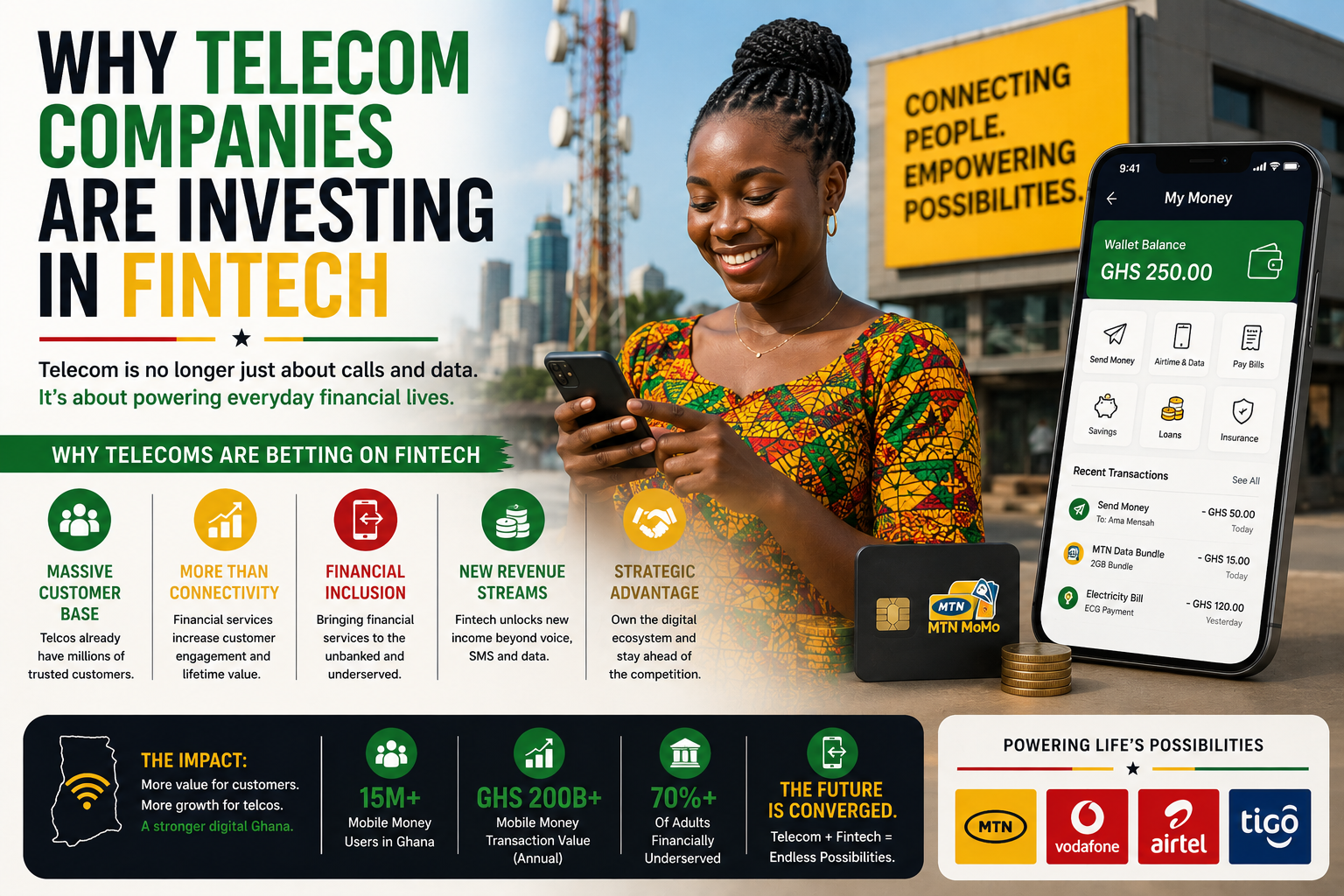

Why Telecom Companies Are Investing in Fintech — MTN Ghana’s fintech revenue hit $549m in 2025, Airtel Africa’s fintech arm processes $193bn annually, and Sub‑Saharan African mobile money transactions reached $1.43 trillion. Our deep‑dive analysis reveals the strategic shift from connectivity to financial services, the super‑app model, regulatory drivers, and three scenarios for Africa’s telecom‑led fintech future.
Executive Introduction
The telecom operator that once simply connected your calls and delivered your data is now quietly becoming your bank, your lender, and your primary financial services provider. Across Africa and beyond, a fundamental realignment is underway: telecommunications companies are pivoting decisively into financial technology, not as a side business, but as a core engine of growth. Traditional services like voice and SMS are in terminal decline, displaced by Over‑The‑Top (OTT) platforms such as WhatsApp, Messenger, and Zoom. In contrast, fintech offers a higher‑margin, faster‑growing revenue stream that leverages the operator’s existing customer base, physical agent network, and vast troves of consumer data.
The numbers tell the story of this transformation. MTN Group’s fintech division processed 549.15 million in revenue in 2025, a 35.7 per cent increase year‑on‑year, driven by 19.3 million active users. Airtel Africa’s fintech division processed an annualised $193 billion in transactions, with revenue up 30.2 per cent, and the company is preparing to publicly list its fintech unit in the second half of 2026 in what could be a 1.43 trillion** in 2025, up 27 per cent from 2024, cementing telecom‑led fintech as the dominant digital finance model on the continent.
📢 GET DETAILED ARTICLES + JOBS
Join THSB's WhatsApp Channel and never miss a post or opportunity.
This profile explains why telecom companies are investing so aggressively in fintech, and why Ghana has become a critical test case for this global trend. It examines the strategic logic behind the shift, the revenue diversification imperative, the rise of the “super‑app” model, the regulatory drivers reshaping the industry, and the competitive dynamics between MTN, Telecel and the emerging fintech challengers. For the telecom operator, fintech is no longer a value‑added service. It is the new core business — and the race to control Africa’s digital wallet is only just beginning.

The Strategic Imperative — Why Voice and Data Are No Longer Enough
The traditional telecom business model is under existential pressure. In mature markets across Africa, voice revenue has been in structural decline for years, displaced by OTT services that telecom operators cannot control. Data revenue, while still growing, is subject to relentless price compression. As networks become more efficient and competition intensifies, the per‑gigabyte price of mobile data has fallen sharply in most markets, squeezing margins.
Telecom operators possess three assets that fintech startups and traditional banks cannot easily replicate. First, they have massive existing customer bases — MTN Group serves over 307 million customers across 16 markets, and Airtel Africa serves approximately 150 million. Second, they have ubiquitous distribution networks — the thousands of mobile money agents who serve as physical cash‑in/cash‑out points are an extension of the telecom network. Third, they have trust and financial data — operators already know their customers’ spending patterns, recharge behaviour, and usage habits.
The strategic logic is compelling. By adding financial services to their core connectivity offering, telecom operators can increase Average Revenue Per User (ARPU), reduce churn, and create new, higher‑margin revenue streams. A customer who uses mobile money for transfers, payments, savings and loans is far more valuable than a customer who only buys airtime. For telecom operators, the alternative to fintech is slow decline in a commoditised connectivity market. The choice is not difficult.
The Revenue Engine — Fintech as the New Growth Pillar
The financial performance of telecom fintech divisions demonstrates why operators are investing so heavily. Fintech is not merely a promising side business; it is, in some markets, the fastest‑growing segment of the entire company.
MTN Group reported service revenue of R218.5 billion ($13.6 billion) for 2025, a 22.9 per cent increase, with fintech revenue up 30.0 per cent. Growth was driven largely by strong performance in key markets, particularly MTN Nigeria and MTN Ghana, which recorded service revenue growth of 54.9 per cent and 35.9 per cent respectively in constant currency terms. The company added 16.3 million net new subscribers, bringing its total customer base to 307.2 million, a 5.6 per cent year‑on‑year increase. Mobile Money active users reached 69.5 million, up 10 per cent year‑on‑year, while fintech transaction volumes rose 14.9 per cent to 23.3 billion transactions. The total value of fintech transactions reached $500.3 billion, representing 37.6 per cent growth.
In Ghana, the story is even more dramatic. MTN MoMo’s revenue jumped 35.7 per cent year‑on‑year to GH¢6.0 billion in 2025, driven by a 12.3 per cent increase in active users to 19.3 million. Advanced services — including digital payments and lending — surged 55.9 per cent to GH¢2.0 billion. Mobile money now accounts for about 25 per cent of MTN Ghana’s total service revenue. The value of funds held in mobile money wallets surged by 60.9 per cent to GH¢38.4 billion, reflecting rising consumer trust.
Across the continent, the trend is consistent. Airtel Africa’s profit after tax skyrocketed by 375 per cent to $376 million for the half‑year ended September 30, 2025, fueled by explosive growth in data consumption and mobile money usage. For the first time in its history, data revenue surpassed voice to become Airtel Africa’s largest revenue driver. The Airtel Money platform posted a 30.2 per cent jump in revenue to $623 million and expanded its customer base by 20 per cent to 49.8 million users. The platform’s annualised transaction value surged 36 per cent to $193 billion. The company will invest up to $900 million in FY2026 to accelerate its 4G, 5G and fintech expansion as it further transforms from a telco into a techco.
The profit potential is not merely theoretical. MTN has a partnership with Mastercard that could see the payments giant take a stake in the fintech business, potentially valuing the unit at over $5 billion. Airtel Africa is targeting an IPO for Airtel Money in the second half of 2026. The IPO could raise between $1.5 billion and 10 billion**, potentially making it one of the largest fintech listings on a European exchange in recent years. These valuations reflect the market’s recognition that telecom‑led fintech platforms possess structural advantages — distribution, data, and customer scale — that standalone fintech startups cannot match.
The Super‑App Model — From Mobile Money to Digital Ecosystems
The most sophisticated telecom operators are not content to offer simple money transfer services. They are building super‑apps — integrated digital ecosystems that combine payments, e‑commerce, lending, insurance, and lifestyle services into a single mobile interface.
Across Africa, the trend is unmistakable. EcoCash, Zimbabwe’s leading mobile money service with more than 8 million accounts, has transformed its platform into a “super app,” moving beyond basic mobile wallet functions to a broader platform that combines messaging, payments, and everyday services within a single interface. The app includes features such as automatic bill splitting, allowing users to divide shared costs instantly, and content monetization tools enabling creators and small businesses to generate income directly through the app. In Togo, Gozem has launched Gozem Money, a mobile money platform developed in partnership with NSIA Bank Togo. In Ethiopia, telebirr, a mobile money app developed through a partnership with Ethio‑Telecom and Huawei, has evolved into a true Super App to address the lack of diversified offerings.
The super‑app strategy is directly relevant to Ghana. MTN Ghana has launched its OneApp platform — a lightweight, data‑saving mobile application that combines core telecom functions (airtime, data, SMS) with MoMo payments, bill settlements, and access to third‑party services. Telecel Ghana is investing heavily in its own digital ecosystem, increasing network infrastructure investment by 150 per cent in 2026, with a focus on enabling advanced digital financial services.
The economic logic of the super‑app is straightforward: the more services a user accesses within the ecosystem, the higher their switching costs, the more data the operator collects, and the greater the opportunities for cross‑selling. A user who pays bills, buys airtime, sends money, and takes a micro‑loan within the same app is far less likely to churn to a competitor. For telecom operators, the super‑app is not merely a product strategy. It is a defensive necessity. If operators do not build these ecosystems, OTT players — global tech giants such as WhatsApp and Google — will capture the customer relationship, relegating telecom companies to the role of dumb pipe providers. The fintech investment is, therefore, a fight for the customer relationship itself.
The Ghana Case — MTN’s Fintech Spinoff and Telecel’s Response
Ghana has become a critical test case for telecom fintech investment. The market is large enough to matter — mobile money transactions reached GH¢4.54 trillion in 2025 — but concentrated enough that the strategic stakes are clear.
MTN Ghana has moved first and most aggressively. The company completed the separation of its mobile money business into a standalone entity, MobileMoney Fintech Ltd (MMFL) , effective 31 March 2026, after receiving all regulatory approvals under Ghana’s Payment Systems and Services Act, 2019 (Act 987). The move positions fintech as an independent growth driver, enabling the unit to attract investment, expand into services such as payments and lending, and achieve a separate valuation from the telecoms arm. The restructuring also aligns with Ghana’s Payment Systems and Services Act, which requires at least 30 per cent local participation in digital financial services businesses. The new entity is jointly owned by MTN Dutch Holdings B.V. (70 per cent) and the MTN Ghana Fintech Trust (30 per cent), which represents local minority shareholders. The Ghana restructuring serves as a model for MTN Group, which plans to roll it out in other African markets, including Nigeria and Uganda.
Telecel Ghana is the second player, but it is not standing still. The company recorded nearly 30 per cent revenue growth in 2025 and declared profits for the first time in years. It plans to increase network infrastructure investment by 150 per cent in 2026, with a focus on enabling digital financial services. Telecel has already deployed over 500 4G sites within a year and aims to reach 2,500 sites within three years. Telecel is also absorbing AT Ghana’s 3.2 million customers, a merger that will boost its subscriber base from approximately 4 million to 7.2 million, increasing its market share from 15 per cent to about 27 per cent. The absorption, while operationally challenging, gives Telecel a larger customer base to which it can cross‑sell fintech services.
The competitive dynamic is clear: MTN is the dominant incumbent, but Telecel is investing heavily to catch up. The newly merged entity will control about 27 per cent of the market — still well below MTN’s dominant position — but the gap in fintech services may be narrower than the gap in connectivity. For Telecel, fintech is the most plausible route to meaningful differentiation.
The Regulatory Driver — Compliance, Localisation, and the Path to Scale
Regulation is not merely a constraint on telecom fintech investment. In Ghana, it has been a catalyst. The Payment Systems and Services Act, 2019 (Act 987) requires electronic money issuers to maintain at least 30 per cent local ownership — a provision designed to ensure that a portion of the economic value generated by mobile money remains within Ghanaian ownership structures.
The Bank of Ghana has fully embraced its role as both regulator and cheerleader of the fintech sector. Governor Dr Johnson Pandit Asiama has described fintechs as “central architects of a new financial order”, and has outlined a regulatory agenda that he framed explicitly as enabling rather than restrictive. The central bank has issued new directives for Digital Credit Services Providers, established licensing procedures with minimum capital requirements, and given unlicensed digital lenders until 30 June 2026 to regularise their operations.
The regulatory push extends beyond compliance to innovation. The BoG’s open banking frameworks, virtual asset legislation, and cross‑border payment initiatives are all designed to create an environment in which fintech can scale. Ghana’s interoperable instant payment infrastructure has processed over GH¢4 trillion annually, and the country is now cited alongside Kenya as one of Africa’s two benchmark digital payments markets. As the Governor noted, “Ghana’s digital financial ecosystem did not evolve by accident. It was built deliberately by entrepreneurs willing to challenge convention, by institutions prepared to modernise, and by a regulator determined to ensure that innovation serves the public good.
The Infrastructure Advantage — Why Telcos Will Likely Win the Fintech Race
Traditional fintech startups and challenger banks face a fundamental challenge that telecom operators do not. They must build distribution networks from scratch, acquire customers at significant cost, and establish trust in a crowded, noisy market. Telecom operators already solved these problems decades ago.
The infrastructure advantage is asymmetrical. Mobile money agents — the physical points of presence for digital wallets — are an extension of the telecom distribution system. There are over 992,000 registered agents in Ghana alone, and 534,000 active agents. No fintech startup could build that network from scratch. The data advantage is equally significant. Telecom operators know their customers’ usage patterns, recharge behaviour, and location history. This data, when combined with mobile money transaction history, provides a rich basis for credit scoring, fraud detection, and personalised product recommendations.
The capital advantage is the final piece. MTN’s $1.1 billion three‑year investment plan in Ghana — including $380 million in 2026 alone — dwarfs what any standalone fintech could raise locally. Airtel Africa’s nearly $900 million capital expenditure plan similarly underscores the scale at which telecom operators are willing to invest in their fintech divisions.
This is not to say that standalone fintechs will disappear. They will continue to innovate in niches, offering specialised products that large operators cannot replicate quickly. But the dominant model for mass‑market digital financial services in Africa is increasingly clear: telecom‑led, super‑app powered, and capital‑intensive. The operators that get it right will not merely participate in the fintech market. They will define it.
Future Outlook — Three Scenarios for Telecom Fintech in Africa
The trajectory of telecom fintech investment will be shaped by three key variables: the success of regulatory efforts to balance competition and inclusion, the pace of super‑app adoption, and the ability of second‑tier operators to challenge dominant players.
Scenario One: Gradual Consolidation of Dominance (65 per cent probability).
In this base case, MTN and Airtel continue to lead the fintech market, with their spinoff entities attracting investment and expanding services. Second‑tier operators make steady progress but remain distant competitors. Open banking frameworks are implemented gradually, enabling some data sharing but not a fundamental restructuring of the market. Mobile money penetration continues to rise, reaching 400‑500 million active users across Africa by 2028. Advanced services — lending, savings, insurance — grow steadily, but basic transfers remain the largest revenue source. The super‑app vision is realised partially but not fully.
Scenario Two: Accelerated Competition (25 per cent probability).
The absorption of weaker players creates genuinely competitive telecom fintech markets in key countries. Regulators aggressively enforce open banking and data‑sharing frameworks, enabling seamless integration across banks, telcos, and fintechs. New mobile virtual network operators (MVNOs) enter the market, focused exclusively on fintech services. Dominant operators are forced to reduce fees and improve service quality. The market becomes genuinely competitive, and consumers benefit from lower costs and more innovative products.
Scenario Three: Stagnation and Fragmentation (10 per cent probability).
Weaker operators fail to integrate effectively, and their fintech services languish. Dominant players’ positions become entrenched, reducing incentives for innovation. Open banking frameworks are delayed or watered down. Data‑sharing across platforms remains fragmented. Cyber fraud erodes trust in mobile money, and user growth stalls. Fintech investment slows, and the market fails to reach its potential. This scenario is the low‑probability, high‑impact risk that keeps regulators focused on competition policy.
The most likely path is Scenario One: gradual consolidation of dominance by the leading players, with second‑tier operators making steady but limited progress. The telecom fintech market will continue to grow, and the operators who invested early will reap the rewards. But the full promise of fintech — universal access to affordable digital financial services — depends on competition, and competition depends on the ability of smaller operators to execute their turnarounds. That remains the central uncertainty of Africa’s fintech future.
Conclusion
The question of why telecom companies are investing in fintech is answered by following the money. MTN Ghana’s fintech revenue grew 35.7 per cent to GH¢6.0 billion in 2025, while its core voice revenue declined as a share of total service revenue. Airtel Africa’s fintech division grew 30.2 per cent, with processed value reaching $193 billion. Across Sub‑Saharan Africa, mobile money transactions reached $1.43 trillion. The numbers are not ambiguous. Fintech is the fastest‑growing, highest‑margin, most strategic segment of the modern telecom business.
The drivers are structural, not cyclical. Voice revenue is in terminal decline, displaced by OTT services that telecom operators cannot control. Data revenue, while still growing, is subject to relentless price compression. The only way for telecom operators to increase ARPU, reduce churn, and create sustainable competitive advantage is to move up the stack — from selling connectivity to selling financial services. Fintech is not a side project. It is the future of the industry.
In Ghana, the transition is already well underway. MTN’s spinoff of its mobile money business into a standalone fintech entity is the most significant corporate restructuring in the sector in years. Telecel is investing 150 per cent more in network infrastructure, with a clear focus on enabling digital financial services. The Bank of Ghana has positioned itself as an enabler rather than an obstacle, launching open banking frameworks, digital credit regulations, and a clear licensing path for fintechs.
The question is no longer whether telecom operators will invest in fintech. They already have, and the returns are visible. The question is whether the market will remain a de facto duopoly — with MTN and Airtel controlling the dominant share — or whether Telecel and other challengers can create genuine competition. For consumers, the stakes are high. Competition drives innovation, lowers prices, and expands access. Without it, the telecom fintech market risks becoming a rent‑extracting oligopoly rather than an inclusive digital economy.
The $549.15 million that MTN MoMo earned in Ghana in 2025 is not merely a revenue number. It is a signal of where the value in telecommunications has migrated. The companies that understand this — and have the capital, regulatory support, and strategic discipline to act on it — will define the next decade of digital finance in Africa. The race is not yet won. But the direction is unmistakable. Your telecom operator is now your bank. And that is unlikely to change anytime soon.
Quick Facts Box
Category || Details
- MTN Group Fintech Transaction Volume (2025) $500.3 billion
- MTN Group Fintech Active Users 69.5 million
- MTN Ghana MoMo Revenue (2025) $549.15 million (GH¢6.0bn)
- MTN Ghana Fintech Share of Service Revenue ~25 per cent
- MTN Ghana Advanced Services Growth 55.9 per cent to GH¢2.0bn
- MTN Ghana MoMo Active Users (2025) 19.3 million
- MTN Ghana Wallet Balances GH¢38.4 billion (+60.9 per cent)
- Airtel Africa Fintech Revenue Growth 30.2 per cent constant currency
- Airtel Africa Fintech Processed Value $193 billion annualised
- Airtel Africa Money User Base 49.8 million (+20 per cent YoY)
- Sub‑Saharan African Mobile Money Transactions (2025) $1.43 trillion (+27 per cent YoY)
- Africa Share of Global Mobile Money 66 per cent of value, 74 per cent of volume
- Airtel Africa Potential IPO Valuation Up to $10 billion
- MTN Fintech Partnership with Mastercard Potential valuation over $5 billion
- MTN Group Total Customers (2025) 307.2 million (+5.6 per cent)
- MTN Group Service Revenue (2025) R218.5 billion ($13.6bn)
- Airtel Africa Profit After Tax (H1 2025) $376 million (+375 per cent)
- Airtel Africa EBITDA Margin 48.5 per cent
- MTN Ghana MoMo Wallet Balance Growth +60.9 per cent to GH¢38.4bn
- Mobile Money Agent Network (Ghana) 992,000 registered, 534,000 active
- Ghana Mobile Money Transaction Value (2025) GH¢4.54 trillion
Frequently Asked Questions (FAQ)
Q1: Why are telecom companies investing so heavily in fintech?
Telecom operators are investing in fintech for three structural reasons. Voice revenue is in terminal decline, displaced by OTT services such as WhatsApp. Data revenue, while still growing, faces relentless price compression. Fintech offers a higher‑margin, faster‑growing revenue stream that leverages the operator’s existing customer base, distribution network, and customer data.
Q2: How much revenue does MTN Ghana generate from mobile money?
MTN Ghana’s mobile money revenue in 2025 reached $549.15 million (GH¢6.0 billion), a 35.7 per cent increase year‑on‑year. Advanced services — including digital payments and lending — surged 55.9 per cent to GH¢2.0 billion. Mobile money now accounts for about 25 per cent of MTN Ghana’s total service revenue.
Q3: How does Airtel Africa’s fintech business compare to MTN’s?
Airtel Africa’s fintech division processed $193 billion annualised, with revenue up 30.2 per cent. The company plans to list its fintech unit in the second half of 2026 in a potential $2 billion IPO. Airtel’s fintech user base grew 20 per cent to 49.8 million.
Q4: What is a “super‑app” and why does it matter for telecom fintech?
A super‑app integrates payments, e‑commerce, lending, insurance, and lifestyle services into a single mobile interface. Examples include EcoCash in Zimbabwe, telebirr in Ethiopia, and MTN’s OneApp in Ghana. The super‑app increases user engagement, raises switching costs, and enables cross‑selling of multiple financial products.
Q5: Why did MTN Ghana spin off its mobile money business?
MTN Ghana completed the separation of its mobile money business into a standalone entity, MobileMoney Fintech Ltd (MMFL), effective 31 March 2026. The move complies with Ghana’s Payment Systems and Services Act, 2019 (Act 987), which requires electronic money issuers to maintain at least 30 per cent local ownership, and positions fintech to attract partnerships and a separate valuation.
Q6: What is the 30 per cent local ownership requirement?
Under Act 987, electronic money issuers in Ghana must maintain at least 30 per cent Ghanaian ownership. MTN complied by establishing the MTN Ghana Fintech Trust, which holds a 30 per cent economic stake in MMFL. The trust benefits non‑MTN Group shareholders of Scancom PLC.
Q7: How does Telecel Ghana compete in fintech?
Ghana plans to increase network infrastructure investment by 150 per cent in 2026, with a focus on enabling digital financial services. The company is absorbing AT Ghana’s 3.2 million customers, boosting its subscriber base from approximately 4 million to 7.2 million. The absorption gives Telecel a larger customer base to which it can cross‑sell fintech services.
Q8: What is the size of the African mobile money market?
Sub‑Saharan African mobile money transactions reached $1.43 trillion in 2025, up 27 per cent from 2024, according to the GSMA’s 2026 State of the Industry Report. Africa accounted for roughly 66 per cent of the global value of mobile money transactions, which totaled $2.09 trillion worldwide.
Q9: How is the Bank of Ghana regulating telecom fintech?
The BoG has issued directives for Digital Credit Services Providers, established licensing procedures, and given unlicensed digital lenders until 30 June 2026 to regularise. It has also passed the Virtual Asset Service Providers Act, 2025 (Act 1154), and launched open banking frameworks. Governor Asiama has described fintechs as “central architects of a new financial order”.
Q10: What is the Mastercard partnership with MTN?
In 2023, MTN struck a partnership with Mastercard that could see the payments giant take a minority stake in MTN’s fintech division. The deal could value the fintech unit at over $5 billion. The spinoff in Ghana is part of the process to complete that deal.
Q11: How does telecom fintech benefit consumers?
Telecom fintech expands access to digital payments, savings, credit, and insurance for populations that traditional banks have not reached. Ghana’s financial inclusion rate rose from 68 per cent in 2021 to 81 per cent in 2025, driven largely by mobile money. Consumers benefit from lower transaction costs, greater convenience, and access to credit based on alternative data.
Q12: What is the outlook for telecom fintech in Africa?
The most likely scenario is gradual consolidation of dominance by leading players like MTN and Airtel, with second‑tier operators making steady but limited progress. Fintech will continue to grow as a share of telecom revenue. Advanced services — lending, savings, insurance — will expand, but basic transfers will remain the largest revenue source. The full promise of fintech depends on whether smaller operators can create genuine competition, which remains uncertain.
Disclaimer: Some content on The High Street Business may be aggregated, summarized, or edited from third-party sources for informational purposes. Images and media are used under fair use or royalty-free licenses. The High Street Business is a subsidiary of SamBoad Publishing under SamBoad Business Group Ltd, registered in Ghana since 2014.
For concerns or inquiries, please visit our Privacy Policy or Contact Page.

Esther Aku-Sika is a content writer and social media strategist who helps brands and startups grow through intentional storytelling and practical marketing strategies. With a keen eye for trends and audience behavior, she shares business insights, content strategies, and real-life lessons to help entrepreneurs build visibility and turn ideas into income. Through her writing, she simplifies complex concepts and equips readers with actionable steps to grow in today’s digital space.