









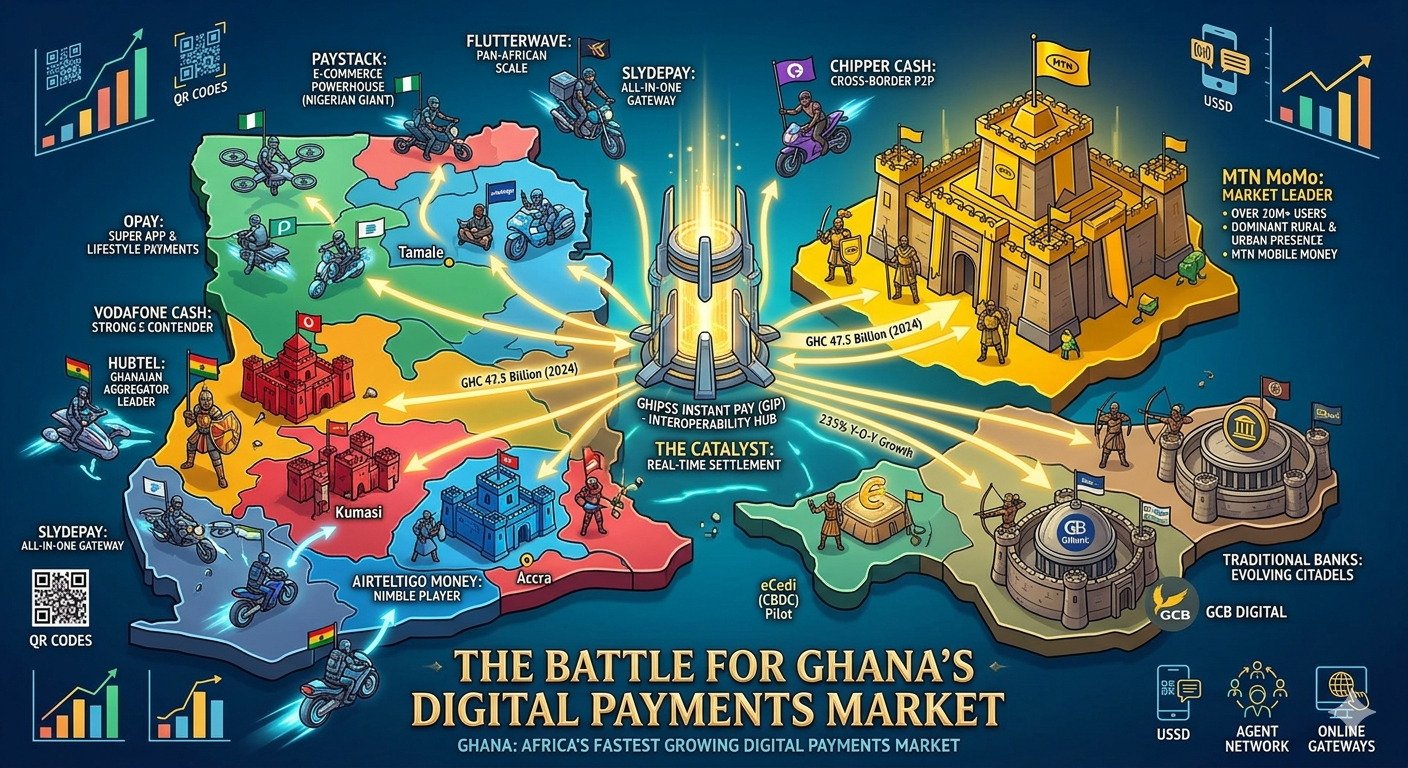

The Battle for Ghana’s Digital Payments Market — Mobile money transactions hit GH¢4.54tn in 2025 with 83m registered accounts. MTN MoMo dominates with GH¢6bn revenue and 19.3m users, but GhanaPay’s zero‑fee bank‑led wallet is gaining ground. Our deep‑dive analysis reveals market structure, profit pools, eCedi implications, and three scenarios for digital payments competition.
Executive Introduction
The numbers are staggering. In April 2026 alone, mobile money transactions in Ghana reached a value of GH¢493.2 billion, involving 967 million individual transactions. Registered mobile money accounts climbed from 75.2 million in April 2025 to 83.0 million in April 2026, while active accounts — those with at least one transaction within 90 days — grew from 24.2 million to 26.0 million. Interoperable transaction values increased to GH¢5.8 billion, volumes rose to 31.7 million, and total mobile money transaction value for the full year 2025 hit GH¢4.54 trillion.
These figures do not represent a sector in gentle growth. They represent a fundamental restructuring of how Ghana’s economy moves value. Cheques — once the backbone of formal business payments — processed just GH¢36.6 billion in April 2026, less than eight per cent of mobile money’s monthly volume. Ghana’s financial inclusion rate has reached 81 per cent, driven largely by mobile money agents and basic phone‑based transactions, and interoperability between mobile money platforms has created a unified payments system, strengthening digital finance as national infrastructure.
📢 GET DETAILED ARTICLES + JOBS
Join THSB's WhatsApp Channel and never miss a post or opportunity.
Yet this vast, GH¢4.54 trillion ecosystem is not a single market. It is a multi‑polar battlefield where three distinct categories of competitor — telco‑led mobile money operators, bank‑led challengers, and nimble fintech startups — are fighting for control of the interface through which Ghanaians access, move and store value.

At the top sits MTN MoMo, whose MobileMoney Limited (MML) reported revenue of GH¢6.0 billion in 2025, a 35.7 per cent increase, driven by 19.3 million active users. Advanced services — digital payments, merchant transactions and mobile lending — grew nearly 56 per cent to GH¢2.0 billion. MTN Ghana’s profit after tax surged 55.9 per cent to GH¢7.8 billion in its 2025 fiscal year, with service revenue reaching GH¢24.4 billion.
At the challenger gate stands GhanaPay, the bank‑owned digital wallet launched by GhIPSS and backed by 23 banks. As of June 2025, GhanaPay had surpassed one million active subscribers, a milestone that validates a fundamentally different approach to digital finance: zero charges on peer‑to‑peer transfers, direct linkage to bank accounts, and features no telco wallet can match, including a high‑yield savings wallet and crowdfunding (susu) capabilities.
In the middle, Telecel Cash (formerly Vodafone Cash) and AT Money fight for relevance, with Telecel’s MD calling for enhanced digital credit solutions and interoperable data‑sharing frameworks to expand access for informal workers.
This profile dissects the battle for Ghana’s digital payments market. It examines the market structure, the profit pools, the regulatory terrain, the emerging threats from bank‑led challengers and open banking, and three scenarios for the future of digital finance in Ghana. The battlefield is crowded. The stakes are enormous. And the outcome will determine who profits from the next decade of Ghana’s digital economy — and who is left behind.
The Market Map — GH¢4.54 Trillion and Counting
Before examining the battle lines, one must understand the terrain. Ghana’s digital payments ecosystem has grown at a pace that few observers predicted even five years ago.
Mobile Money Dominance
Mobile money now processes over 97 per cent of digital transaction volume in Ghana and accounts for 72 per cent of total transaction value. Total mobile money transaction value for 2025 reached GH¢4.54 trillion, up from GH¢3.02 trillion in 2024 — a 53.8 per cent increase. In December 2025 alone, festive spending drove monthly transaction values to a peak of GH¢518.4 billion, with transaction volumes rising to 982 million.
Registered mobile money accounts hit 83.0 million by April 2026, far surpassing the adult population of roughly 20 million. Customer wallet balances reached GH¢39.6 billion, the highest level in 2025, pointing to growing trust in mobile wallets not only as a payment tool but also as a safe store of value.
The Shift Away from Traditional Channels
The migration from traditional payment channels to digital alternatives has accelerated. ATM weekly usage declined from 34 per cent in 2024 to 16 per cent in 2025, marking the second consecutive year of decline. For the first time in three years, ATM services have declined in priority, replaced by urgent demand for digital resilience. Cheque transaction value in April 2026 stood at GH¢36.6 billion — less than eight per cent of mobile money’s monthly volume.
Interoperability Gains Momentum
Interoperability — the ability to transfer money across different mobile money networks — has gained meaningful traction. Transaction values rose to GH¢5.8 billion in December 2025 from GH¢4.9 billion in November, with volumes climbing from 23.1 million to 31.7 million. However, interoperability still accounts for only about 1 per cent of total transaction value, indicating most activity remains within walled‑garden networks.
Deepening Behavioral Entrenchment
In 2026, 44.6 per cent of consumers reported expanding their mobile money usage — the highest level observed in six years. At the same time, only 5.7 per cent reported contracting their usage, signalling deepening entrenchment rather than temporary adoption. The shift from cash to digital is not a passing trend. It is a structural transformation.
The 800‑Pound Gorilla — MTN MoMo’s Unassailable Lead
MTN MoMo is not merely a participant in Ghana’s digital payments market. In many respects, it is the market.
The numbers are staggering. In 2025, MTN MoMo’s revenue jumped 35.7 per cent to GH¢6.0 billion, accounting for nearly a quarter of MTN Ghana’s total service revenue. Active users grew 12.3 per cent year‑on‑year to 19.3 million. Basic services — cash‑in/cash‑out, peer‑to‑peer transfers, and standard merchant payments — grew by 27.2 per cent, largely driven by increased transfer volumes after the abolition of the Electronic Transfer Levy (E‑Levy) in April 2025.
Advanced services — digital payments, merchant transactions, mobile lending, and savings — surged 55.9 per cent to GH¢2.0 billion. The value of funds held in mobile money wallets surged 60.9 per cent to GH¢38.4 billion, reflecting rising consumer trust and the platform’s evolution from a payments utility to a full‑service digital bank.
The Spinoff That Changes Everything
In April 2026, MTN completed the separation of its Ghana MoMo business into a standalone fintech entity, MobileMoney Fintech Ltd (MMFL). The move complies with Ghana’s Payment Systems and Services Act, 2019 (Act 987), which requires electronic money issuers to maintain at least 30 per cent local ownership. The new entity is jointly owned by MTN Dutch Holdings B.V. (70 per cent) and the MTN Ghana Fintech Trust (30 per cent), which represents local minority shareholders.
The restructuring does not alter MTN Ghana’s shareholding in its core telecommunications business, but it positions fintech as an independent growth engine capable of attracting dedicated investment and partnerships. Mastercard is already expected to take a minority stake, and the spinoff in Ghana serves as a model for MTN Group to roll out in other African markets, including Nigeria and Uganda.
The Flywheel Effect
MTN’s dominance in mobile money is reinforced by its dominance in mobile subscriptions and data. The company controls approximately 73.87 per cent of the mobile subscription market and 81.29 per cent of data subscriptions. Its 4G population coverage stands at 99.2 per cent. Every MTN subscriber is a potential MoMo user, and every MoMo user generates data traffic, which drives data revenue, which funds network investment, which attracts more subscribers — and the cycle continues.
The MoMo flywheel is the single most important structural feature of Ghana’s digital payments market. It is also the feature that makes competition so difficult.
The Distant Challengers — Telecel Cash and AT Money
If MTN MoMo is the Goliath of Ghana’s digital payments market, Telecel Cash and AT Money are the Davids — armed, determined, but fighting from a position of profound disadvantage.
Telecel Cash — The No. 2 Player
Telecel Cash, the successor to Vodafone Cash, has maintained a relatively stable position as the second‑largest mobile money operator, with an estimated 15‑20 per cent market share. The company recorded nearly 30 per cent revenue growth in 2025 and declared profits for the first time in years. It plans to increase network infrastructure investment by 150 per cent in 2026, with a focus on enabling digital financial services.
Telecel has also taken strategic steps to differentiate itself. The company enabled Google Play payments in Ghana, integrating mobile money with mainstream digital commerce. Its managing director, Philip Amoateng, has called for the creation of regulated data‑sharing frameworks that would enable banks, telecom operators, and fintechs to share customer data to improve credit decision‑making. Speaking at the 3i Africa Summit 2026, Amoateng stated that Telecel Cash utilises alternative data — including telecom usage and mobile money transaction patterns — to support small overdrafts and short‑term loans for underserved consumers and mobile money agents.
Yet Telecel Cash faces significant headwinds. The company has suffered from platform downtime and degraded performance, which has affected its reliability. Moreover, its network coverage cannot match MTN’s 99.2 per cent 4G population coverage.
AT Money — The Struggling Third Player
AT Money (formerly AirtelTigo Money) is the most marginalised of the three mobile money operators. AT Ghana’s market share has sharply declined, prompting the government to negotiate a sale of a 60 per cent stake to Canadian firm Rektron Group and local partner Afritel to inject fresh capital. AT Money has focused on micro‑lending as a differentiator, offering small loans with quick approvals. But without a competitive network or a substantial customer base, its ability to challenge the incumbents is severely limited.
The Telecel‑AT Absorption
The government has mandated that Telecel absorb AT Ghana’s 3.2 million customers, a merger that will boost Telecel’s subscriber base from approximately 4 million to 7.2 million, increasing its market share from 15 per cent to about 27 per cent. However, Telecel’s active data subscribers stand at 4.9 million, compared to MTN’s 19.9 million. The gap remains vast, and the absorption will test Telecel’s operational capacity as much as it will strengthen its market position.
The Bank‑Led Revolution — GhanaPay’s Zero‑Fee Challenge
The most serious challenge to MTN MoMo’s dominance does not come from a telco. It comes from the banks.
GhanaPay — The Industry‑Wide Response
Launched in 2022 by GhIPSS and backed by 23 banks, GhanaPay is a bank‑owned digital wallet designed as a collaborative industry platform to reclaim market share in digital payments. By June 2025, GhanaPay had surpassed one million active subscribers — up from 212,130 in 2022, a 373 per cent increase — and now supports nearly 1,000 active business endpoints, enabling retail payments and commercial utility.
GhanaPay’s value proposition is fundamentally different from that of the telco‑led wallets. The platform offers zero charges on peer‑to‑peer transfers, direct linkage to bank accounts, and features that no telco wallet can match, including a high‑yield savings wallet and crowdfunding (susu) capabilities. The removal of the E‑Levy in 2025 supercharged adoption, making all transactions on the platform completely free.
The platform’s high‑yield savings wallet is particularly notable. Unlike MTN MoMo, which pays no interest on wallet balances — though it earns substantial interest income on the float held in trust accounts — GhanaPay’s savings product offers depositors a return on their funds, directly challenging MTN MoMo’s value proposition.
The Merchant Network Challenge
GhanaPay’s greatest challenge is not its technology or its features. It is its distribution. The platform has nearly 1,000 active business endpoints, compared to MTN MoMo’s 992,000 registered agents and 534,000 active agents. A customer can cash‑in or cash‑out at almost any corner in Ghana using MTN MoMo. GhanaPay’s agent network is still in its infancy.
The platform also faces the challenge of visibility. Most Ghanaians interact with GhanaPay through their bank’s mobile app, not through a standalone application. This integration is seamless for customers who already bank with a GhanaPay partner institution, but it makes the platform invisible as a brand.
The Potential for Breakthrough
If GhanaPay can scale its agent network and continue to offer zero‑fee transfers, it could become a genuine alternative to MTN MoMo for the millions of Ghanaians who are already banked but use mobile money for convenience. The platform’s integration with the Ghana Card digital wallet — which links biometric identity directly to payments — could further accelerate adoption. With the Ghana Card now mandatory for all banking and digital transactions, the infrastructure for seamless, identity‑verified payments is falling into place.
Yet the gap between GhanaPay’s one million subscribers and MTN MoMo’s 19.3 million active users is vast. Closing that gap will require sustained investment, aggressive merchant acquisition, and a customer acquisition strategy that matches MTN’s scale.
The Fintech Insurgents — The Wild Cards
Beyond the telco‑led and bank‑led players, a third category of competitor is emerging: standalone fintech startups that are building payment platforms unaffiliated with either telecom operators or traditional banks.
Digital Credit Providers
The digital lending market is formalising. In 2025, the Bank of Ghana introduced a new digital credit service provider licence to organise and formalise activities in the digital lending market, allowing the provision of low‑value, short‑term credit through digital channels. All existing operators must apply by 30 June 2026.
Fido Ghana raised US$5.5 million in debt in March 2026 to expand its digital lending operations. Adehyeman, under a two‑year rollout plan from 2026 to 2027, plans to provide GH¢30 million in loans to around 1,500 MSMEs through Oze’s digital lending platform. These platforms use transaction data and alternative credit scoring to assess risk — bypassing the collateral requirement that blocks most SMEs from traditional bank credit.
The eCedi and Digital Identity
The impending launch of the Digital Cedi (eCedi) pilot expansion threatens to blur the lines between traditional banking and mobile money even further. The eCedi is a central bank digital currency (CBDC) — a digital form of the cedi issued and backed by the Bank of Ghana. If successfully deployed, the eCedi could provide a government‑backed digital payment option that competes directly with both MTN MoMo and GhanaPay.
The Ghana Card digital wallet — which links biometric identity directly to payments — is another potential game‑changer. By linking national identity to a payment wallet, Ghana lays the groundwork for a future in which every citizen has a government‑verified digital wallet for receiving transfers, paying taxes, and accessing government services. If the eCedi and Ghana Card wallet are integrated, the government could effectively become a competitor in the digital payments market.
The Open Banking Horizon
The Bank of Ghana has announced plans to introduce new regulatory frameworks for open banking, digital banking and digital credit by the end of 2026. Open banking would allow third‑party fintechs, with customer consent, to access bank data and offer competing services. For digital payments, open banking could enable a new generation of payment applications that aggregate accounts from multiple banks and mobile money wallets, reducing switching costs and increasing competition.
The BoG’s National Payment Systems Strategy (2025‑2029) prioritises interoperability, open banking and digital infrastructure as key enablers of growth and inclusion. Ghana retained its position as the world’s top‑ranked country for mobile money regulation, scoring 96.10 per cent on the 2025 GSMA Mobile Money Regulatory Index. The regulatory environment is not merely permissive. It is actively enabling competition.
The Profit Pools — Who Captures the Value
Beneath the battle for market share lies a more fundamental question: who actually captures the economic value generated by Ghana’s digital payments ecosystem?
Telco‑Led Model — High Volume, High Margin
MTN MoMo’s model is built on transaction fees (cash‑out, transfers, bill payments), float income (interest earned on the GH¢38.4 billion held in customer wallets), merchant discount rates, mobile lending fees, and advanced services. The economics are attractive. Mobile money now accounts for about 25 per cent of MTN Ghana’s total service revenue, and advanced services are growing at nearly 56 per cent annually.
The telco model’s greatest strength is its ability to cross‑subsidise. Data revenue funds network investment, which enables MoMo transactions, which generate transaction fees, which fund further investment. The flywheel is self‑reinforcing.
Bank‑Led Model — Zero‑Fee Acquisition, Interest‑Based Retention
GhanaPay’s model is fundamentally different. The platform does not charge for peer‑to‑peer transfers, eliminating its primary revenue stream. Instead, GhanaPay generates value through its high‑yield savings wallet — attracting deposits that can be lent out by the partner banks — and through the customer acquisition value of bringing users into the banking ecosystem. A customer who signs up for GhanaPay is a customer who may eventually open a savings account, take a loan, or buy an investment product from one of the 23 partner banks.
The challenge for GhanaPay is that zero‑fee transfers generate no immediate revenue. The platform must scale rapidly to make the customer acquisition economics work. At one million subscribers, the economics are still unproven.
Fintech Model — Niche Specialisation
Standalone fintechs cannot compete with MTN MoMo on distribution scale or with GhanaPay on zero‑fee pricing. Their strategy is niche specialisation: digital lending, cross‑border payments, creator economy wallets, or business‑focused payment processing.
The Akuna Wallet, which entered the Bank of Ghana’s Virtual Assets Regulatory Sandbox to test Stellar‑based cross‑border payment tools for creators and freelancers, exemplifies this approach. Fintechs will not defeat MTN MoMo. But they can capture profitable niches that the larger players have neglected.
The table below summarises the three competitive models and their respective strengths and weaknesses.
Model || Player || Revenue || Model Strengths Weaknesses
- Telco‑led MTN MoMo Transaction fees, float income, lending Massive scale, agent network, data flywheel High fees for basic services, concentrated market power
Bank‑led GhanaPay Savings interest, customer acquisition Zero‑fee transfers, bank integration, high‑yield savings Tiny agent network, limited merchant acceptance, low visibility - Fintech Fido, Oze, Akuna Lending interest, processing fees, subscriptions Agile, specialised, no legacy infrastructure Small customer base, high customer acquisition costs
The Consumer Shift — What Users Actually Want
The battle for Ghana’s digital payments market is not merely a corporate contest. It is shaped by the preferences and behaviours of 26 million active mobile money users.
The Migration from Cash to Digital Is Deepening
In 2026, 44.6 per cent of consumers reported expanding their mobile money usage — the highest level observed in six years. Only 5.7 per cent reported contracting their usage, signalling deepening entrenchment rather than temporary adoption. Mobile money is not a fad. It is the new normal.
Price Sensitivity Is High
The abolition of the E‑Levy in April 2025 had a measurable impact on transaction volumes. MTN MoMo’s basic services grew 27.2 per cent year‑on‑year, largely driven by increased transfer volumes after the removal of the tax disincentive. GhanaPay’s zero‑fee proposition has attracted over one million subscribers. Consumers are price‑sensitive, and fee structures matter.
Trust Remains a Constraint
Despite the sector’s growth, trust remains fragile. Cyber fraud losses rose from GH¢2.4 million in Q1 2024 to GH¢14.94 million in the first half of 2025. Approximately 25 per cent of all insurance claims in Ghana show elements of fraud, and the same fraud networks target mobile money platforms. SIM swapping, phishing attacks, and fake customer service numbers continue to drain accounts. Trust is not guaranteed. It is earned — and it can be lost.
The Need for Credit Is Unmet
For many Ghanaians, especially those in the informal sector, digital credit is used for school fees and healthcare. Telecel Cash’s MD has called for enhanced digital credit solutions, noting that his platform uses alternative data — including telecom usage and mobile money transaction patterns — to support small overdrafts and short‑term loans for underserved consumers. The demand for credit is immense. The supply is still constrained by data fragmentation and risk aversion.
The Regulatory Chessboard — The Rules That Shape the Battle
The Bank of Ghana is not a neutral observer in the battle for digital payments. It is an active shaper of the rules of engagement.
The Ghana Card Mandate
Under new guidance effective from October 2025, all BoG‑licensed and regulated financial institutions are required to use the Ghana Card as the only identification document when onboarding customers. The guidance imposes tougher requirements for mobile and internet banking, citing heightened money laundering and terrorist financing risks. The Ghana Card mandate has improved identity verification but added an administrative step that may deter some customers.
The Local Ownership Requirement
Act 987 requires electronic money issuers to maintain at least 30 per cent local ownership — a provision designed to ensure that a portion of the economic value generated by mobile money remains within Ghanaian ownership structures. MTN’s compliance through the MMFL spinoff is the most visible response, but other operators will eventually need to meet the same requirement.
The BoG’s Dual Role as Enabler and Enforcer
Governor Dr Johnson Pandit Asiama has described fintechs as “central architects of a new financial order” and has outlined a regulatory agenda that includes open banking, virtual asset integration, cross‑border payment innovation, and a diaspora investment corridor supported by blockchain and tokenisation infrastructure.
Yet the BoG is also an enforcer. The Ghana Card mandate, the digital credit licensing requirement with a 30 June 2026 deadline, and the revised Cyber and Information Security Directive (CISD 2026) all impose compliance costs that smaller players may struggle to absorb.
The Open Banking Promise
The BoG has stated that it plans to introduce new regulatory frameworks for open banking, digital banking and digital credit by the end of 2026 as part of efforts to expand financial access and support SMEs. Open banking would allow third‑party fintechs, with customer consent, to access bank data and offer competing services. For digital payments, open banking could lower switching costs and increase competition. But the timing and scope of implementation remain uncertain.
The table below summarises the key regulatory interventions shaping the digital payments landscape.
Intervention Status Impact on Competition
- Ghana Card mandate, Effective Oct 2025, Benefits established players with KYC infrastructure
30% local ownership (Act 987), Enforced MTN compliant via MMFL; others to follow - Digital credit licensing, Deadline 30 June 2026, Formalises lending market; compliance cost for small lenders
- Open banking framework, By end‑2026, Potentially transformative; reduces switching costs
eCedi pilot Underway Could enable government‑backed digital wallet - Ghana Card digital wallet, Active, Links biometric ID to payments; potential game‑changer
Future Outlook — Three Scenarios for the Digital Payments Battle
The trajectory of Ghana’s digital payments market will be shaped by three variables: the success of GhanaPay’s agent network expansion, the pace of open banking implementation, and the willingness of consumers to migrate from telco‑led wallets to bank‑led alternatives.
Scenario One: MTN MoMo Consolidates Its Dominance (65 per cent probability)
In this base case, MTN MoMo’s market share remains above 70 per cent. GhanaPay scales to 5‑8 million subscribers but cannot match MTN’s agent network reach. Telecel Cash stabilises its market share at 15‑20 per cent but does not meaningfully challenge MTN. The eCedi pilot remains limited in scope. Open banking is implemented gradually, enabling some data sharing but not a fundamental restructuring of the market. Mobile money transaction value continues to grow at 15‑20 per cent annually, but MTN captures the majority of the value. The battle is not won — but it is not seriously contested.
Scenario Two: The Bank‑Led Breakthrough (25 per cent probability)
GhanaPay successfully expands its agent network to 10,000+ active endpoints, driven by the Ghana Card digital wallet integration. The eCedi is launched as a fully interoperable digital currency, creating a government‑backed alternative to MTN MoMo. Open banking is implemented aggressively, enabling fintechs to offer payment aggregation services that reduce switching costs. Consumer awareness of GhanaPay’s zero‑fee proposition spreads, and the platform’s subscriber base reaches 8‑10 million. MTN MoMo is forced to reduce its fees to retain customers. The market becomes genuinely competitive, and consumers benefit from lower costs.
Scenario Three: Entrenchment and Stagnation (10 per cent probability)
GhanaPay fails to scale its agent network, remaining a niche product for banked urban customers. Telecel’s absorption of AT Ghana proves operationally difficult, and its fintech services languish. Open banking is delayed indefinitely. The eCedi pilot faces technical challenges and is not deployed at scale. MTN’s market share edges toward 80 per cent. Fee reductions stall. Fintech startups struggle to compete. The market grows, but the value is increasingly concentrated in a single operator.
The most likely path is Scenario One: gradual consolidation of MTN’s dominance, with GhanaPay and Telecel Cash making steady but limited progress. The digital payments market will continue to grow, and MTN will continue to capture the majority of the value. The full promise of a competitive, inclusive digital payments ecosystem depends on whether GhanaPay can scale its agent network and whether open banking is implemented effectively. Those remain the central uncertainties of Ghana’s digital payments future.
Conclusion
Ghana’s digital payments market is not a market. It is a battlefield. On one side stands MTN MoMo, the telco‑led giant with 19.3 million active users, GH¢6.0 billion in annual revenue, and a flywheel that makes its dominance self‑reinforcing. On the other stands GhanaPay, the bank‑led challenger backed by 23 financial institutions, offering zero‑fee transfers and high‑yield savings, but still struggling to match MTN’s distribution reach. In the middle, Telecel Cash fights for relevance, and a growing army of fintech startups picks at the edges of the market, capturing niches that the larger players have neglected.
The numbers are not ambiguous. GH¢4.54 trillion in annual mobile money transactions. 83 million registered accounts. 26 million active users. Financial inclusion at 81 per cent. The infrastructure of a digital economy is being built, and it is being built fast.
Yet the gap between registered accounts and active users — 83 million versus 26 million — reminds us that not every account is being used. The decline in active agents from earlier peaks suggests that the physical backbone of the system is under strain. The 44.6 per cent of consumers expanding their usage is good news, but the 5.7 per cent contracting their usage is a reminder that trust is fragile and that competition is necessary.
The Bank of Ghana has set the rules of engagement: local ownership, Ghana Card verification, open banking, digital credit licensing, and a regulatory framework that keeps Ghana at the top of global rankings for mobile money regulation. The battlefield is prepared. The competitors are in position. The battle is underway.
The question is not whether Ghana’s digital payments market will continue to grow. It will. The question is who will capture the value of that growth — and whether that value will be shared broadly or concentrated in a single dominant operator. The eCedi, open banking, and GhanaPay’s zero‑fee model all have the potential to reshape the competitive landscape. But potential is not reality. Execution will determine the outcome.
The battle for Ghana’s digital payments market is not a contest of technology. It is a contest of distribution, trust, and regulatory alignment. MTN has the distribution. GhanaPay is building it. The banks have the trust. Open banking may level the playing field. The next 24 months will determine who wins — and whether Ghana’s digital payments future is a market or a monopoly.
Quick Facts Box
Category || Details
- Market Size Mobile money: GH¢4.54 trillion (2025); Mobile money: GH¢493.2bn (April 2026)
- Registered Mobile Money Accounts (April 2026) 83.0 million
- Active Mobile Money Accounts (90‑day) 26.0 million
- Registered Mobile Money Agents (April 2026) 992,000
- Active Mobile Money Agents (April 2026) 534,000
- Mobile Money Float Balance (April 2026) GH¢36.7 billion
- Interoperability Transaction Value (April 2026) GH¢5.8 billion
- Cheque Transaction Value (April 2026) GH¢36.6 billion
- MTN MoMo Active Users (2025) 19.3 million
- MTN MoMo Revenue (2025) GH¢6.0 billion (+35.7% YoY)
- MTN MoMo Advanced Services Revenue GH¢2.0 billion (+55.9% YoY)
- MTN Group Fintech Transaction Volume (2025) $500.3 billion
- GhanaPay Active Subscribers (June 2025) 1+ million
- GhanaPay Business Endpoints Nearly 1,000
- Financial Inclusion Rate (2026) 81 per cent
- GSMA Mobile Money Regulatory Index (2025) Ghana #1 globally (96.10%)
- BoG Open Banking Framework Planned by end‑2026
- Digital Credit Licensing Deadline 30 June 2026
- eCedi Status Pilot expansion underway
- Key Regulators Bank of Ghana, GhIPSS
Frequently Asked Questions (FAQ)
Q1: How big is Ghana’s digital payments market?
Total mobile money transaction value reached GH¢4.54 trillion in 2025, up from GH¢3.02 trillion in 2024 — a 53.8 per cent increase. In April 2026 alone, transactions hit GH¢493.2 billion across 967 million transactions. Registered mobile money accounts reached 83.0 million, while active accounts (90‑day) stood at 26.0 million.
Q2: Who are the main players in Ghana’s digital payments market?
Three categories compete: telco‑led mobile money operators (MTN MoMo, Telecel Cash, AT Money), bank‑led challengers (GhanaPay, backed by 23 banks and GhIPSS), and standalone fintech startups (Fido, Oze, Akuna Wallet). MTN MoMo dominates with 19.3 million active users and GH¢6.0 billion in annual revenue.
Q3: How dominant is MTN MoMo in Ghana?
MTN MoMo’s revenue reached GH¢6.0 billion in 2025, accounting for about 25 per cent of MTN Ghana’s total service revenue. Active users grew 12.3 per cent to 19.3 million. Advanced services — including digital payments and lending — surged 55.9 per cent to GH¢2.0 billion. The platform’s wallet balances rose 60.9 per cent to GH¢38.4 billion.
Q4: What is GhanaPay and how does it compete with MTN MoMo?
GhanaPay is a bank‑owned digital wallet launched by GhIPSS and backed by 23 banks. It offers zero charges on peer‑to‑peer transfers, direct linkage to bank accounts, a high‑yield savings wallet, and crowdfunding (susu) capabilities. As of June 2025, it had surpassed one million active subscribers — up from 212,130 in 2022, a 373 per cent increase — and supports nearly 1,000 active business endpoints.
Q5: What is the eCedi and how will it affect digital payments?
The eCedi is Ghana’s central bank digital currency (CBDC) — a digital form of the cedi issued and backed by the Bank of Ghana. Its pilot expansion is underway. If successfully deployed, the eCedi could provide a government‑backed digital payment option that competes directly with both MTN MoMo and GhanaPay.
Q6: What is open banking and when will it come to Ghana?
Open banking allows third‑party fintechs, with customer consent, to access bank data and offer competing services. The Bank of Ghana has announced plans to introduce new regulatory frameworks for open banking, digital banking and digital credit by the end of 2026. Open banking could lower switching costs and increase competition in digital payments.
Q7: What is the Ghana Card digital wallet?
The Ghana Card digital wallet links biometric identity directly to payments. By linking national identity to a payment wallet, Ghana lays the groundwork for a future in which every citizen has a government‑verified digital wallet for receiving transfers, paying taxes, and accessing government services. The Ghana Card is now mandatory for all banking and digital transactions under BoG guidance.
Q8: How much do mobile money agents earn?
Agent commission structures vary by operator. For MTN MoMo cash‑out: GH¢0.20 for amounts under GH¢50; 0.4 per cent for transactions between GH¢50 and GH¢2,000; flat GH¢8 for amounts above GH¢2,000. Agents also earn commissions on cash‑in, bill payments and airtime sales. Average monthly earnings range from GH¢1,500 to GH¢6,000+, but agent liquidity shortages remain the primary cause of agent inactivity.
Q9: What is the 30 per cent local ownership requirement?
Under Ghana’s Payment Systems and Services Act, 2019 (Act 987), electronic money issuers must maintain at least 30 per cent local ownership. MTN Ghana complied by spinning off its mobile money business into MobileMoney Fintech Ltd (MMFL), jointly owned by MTN Dutch Holdings (70 per cent) and the MTN Ghana Fintech Trust (30 per cent), which represents local minority shareholders.
Q10: How does digital lending work in Ghana?
Digital lending platforms use transaction data and alternative credit scoring to assess risk, bypassing the traditional collateral requirement. Telecel Cash uses telecom usage and mobile money transaction patterns to support small overdrafts and short‑term loans. The Bank of Ghana has introduced a digital credit service provider licence, with all existing operators required to apply by 30 June 2026.
Q11: How does mobile money interoperability work in Ghana?
Interoperability allows users to transfer money across different mobile money networks (e.g., from MTN MoMo to Telecel Cash). Transaction values rose to GH¢5.8 billion in December 2025, with volumes climbing to 31.7 million. However, interoperability still accounts for only about 1 per cent of total transaction value, indicating most activity remains within network‑specific walled gardens.
Q12: What is the future outlook for digital payments competition in Ghana?
The most likely scenario is gradual consolidation of MTN MoMo’s dominance, with GhanaPay scaling to 5‑8 million subscribers but unable to match MTN’s agent network. The market will continue to grow, with total transaction value expected to reach GH¢6‑7 trillion by 2028. A genuine breakthrough would require GhanaPay to successfully scale its agent network, open banking to be implemented aggressively, and the eCedi to be launched as a fully interoperable digital currency — all of which remain uncertain.
Disclaimer: Some content on The High Street Business may be aggregated, summarized, or edited from third-party sources for informational purposes. Images and media are used under fair use or royalty-free licenses. The High Street Business is a subsidiary of SamBoad Publishing under SamBoad Business Group Ltd, registered in Ghana since 2014.
For concerns or inquiries, please visit our Privacy Policy or Contact Page.

Esther Aku-Sika is a content writer and social media strategist who helps brands and startups grow through intentional storytelling and practical marketing strategies. With a keen eye for trends and audience behavior, she shares business insights, content strategies, and real-life lessons to help entrepreneurs build visibility and turn ideas into income. Through her writing, she simplifies complex concepts and equips readers with actionable steps to grow in today’s digital space.