
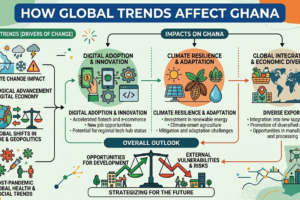


Innovation is no longer optional for businesses in Ghana—it is a core driver of growth, competitiveness, and resilience. Across sectors from fintech to agribusiness, logistics to manufacturing, new technologies, business models, and digital tools are transforming how Ghanaian businesses operate, deliver value, and expand.
In 2026, Ghana’s economy is experiencing a wave of innovation-driven change. Entrepreneurs, SMEs, and large corporations are leveraging technological adoption, process improvement, and creative strategies to navigate market challenges, capture new opportunities, and enhance productivity.
Understanding innovation trends is essential for business owners, investors, and policymakers who aim to remain competitive in an evolving economic landscape.
📢 GET A DETAILED ARTICLES + JOBS
Join SamBoad's WhatsApp Channel and never miss a post or opportunity.
Digitalization and the Rise of Tech-Enabled Services
Digital technology is transforming business operations in Ghana. Mobile payments, digital banking, e-commerce platforms, and online service delivery are reshaping consumer behavior and supply chains.
Fintech innovations, for instance, allow SMEs to access credit, accept payments, and manage financial records efficiently. E-commerce platforms expand market reach beyond local neighborhoods to regional and global customers.
Digitalization also improves efficiency. Businesses using automated inventory systems, customer relationship management tools, and digital marketing platforms reduce operational costs while enhancing customer experience.
The trend toward tech-enabled services is not limited to urban centers—rural and peri-urban markets are also increasingly adopting mobile and digital solutions, expanding the potential customer base for businesses.
Agritech and Modernizing Agriculture
Agriculture remains a cornerstone of Ghana’s economy, and innovation is transforming the sector. Agritech solutions—ranging from precision farming, mobile-based advisory services, and farm management apps—are helping farmers increase yields, reduce waste, and improve market access.
Supply chain innovations, including cold storage solutions and digital marketplaces, reduce post-harvest losses and connect farmers directly with buyers.
For businesses involved in agribusiness, understanding and adopting agritech solutions improves efficiency, lowers costs, and strengthens competitiveness.
Manufacturing and Industrial Innovation
Innovation in manufacturing is reshaping Ghana’s industrial landscape. Local firms are adopting process automation, smart machinery, and quality control systems to enhance production efficiency.
Value addition in key sectors such as food processing, textiles, and packaging is increasing. Manufacturers leveraging innovation produce higher-quality products for local consumption and export markets.
Entrepreneurs using innovative production methods gain cost advantages, improved consistency, and market differentiation.
Green Innovation and Sustainable Business Practices
Sustainability and innovation are converging. Green energy solutions, waste recycling, and eco-friendly production methods are becoming central to business strategies.
Solar energy adoption, energy-efficient equipment, and sustainable logistics reduce operating costs while improving corporate social responsibility profiles.
Investors increasingly consider sustainability when evaluating business potential, making green innovation both a cost-saving and growth strategy.
Data-Driven Decision Making
Data collection, analytics, and business intelligence tools are transforming how Ghanaian businesses make decisions. Access to consumer data, market trends, and operational performance enables informed strategies.
Small businesses using point-of-sale analytics, digital surveys, or mobile platforms can optimize pricing, inventory, and marketing decisions.
Data-driven approaches reduce guesswork, improve competitiveness, and increase resilience against market fluctuations.
Fintech and Financial Innovation
Financial innovation continues to drive inclusion and efficiency in Ghana. Mobile money, digital lending platforms, and blockchain applications are expanding access to finance, reducing transaction costs, and enabling cross-border trade.
SMEs can now secure short-term financing without traditional collateral, facilitating growth and expansion. Digital payments improve cash flow management and transparency.
The rise of fintech is creating new business models and partnerships across sectors, stimulating entrepreneurship and economic activity.
Innovation in Logistics and Supply Chain Management
Modern logistics solutions are streamlining supply chains. GPS tracking, fleet management software, and automated inventory systems improve delivery efficiency and reduce costs.
For importers, exporters, and retailers, these innovations reduce delays, improve service reliability, and strengthen competitiveness.
Efficient logistics enable businesses to scale operations and reach previously underserved markets.
Skills, Education, and Human Capital Innovation
Innovation is not only technological—it also involves human capital. Training programs, online courses, and vocational upskilling equip the workforce to adopt new technologies and processes.
Businesses investing in employee skills gain productivity, adaptability, and the capacity to implement innovative strategies effectively.
Human capital innovation ensures that technological advances translate into tangible business outcomes.
Collaboration, Ecosystems, and Entrepreneurship
Innovation thrives in ecosystems that connect entrepreneurs, investors, academia, and government support. Incubators, accelerators, and co-working spaces in Ghana are facilitating collaboration, mentorship, and access to capital.
Startups and SMEs leverage these ecosystems to test ideas, scale operations, and enter new markets.
Collaboration accelerates adoption of innovations and fosters a culture of creativity and problem-solving.
Policy Support for Innovation
Government policy and reform play a key role in enabling innovation. Incentives for technology adoption, tax breaks for research and development, and investment in digital infrastructure support private sector innovation.
Policies that promote digitalization, industrialization, and entrepreneurship create opportunities for businesses to leverage innovation to compete locally and globally.
Predictable policy frameworks increase investor confidence and encourage adoption of advanced technologies.
The Economic Impact of Innovation
Innovation drives productivity, efficiency, and competitiveness, ultimately boosting Ghana’s economic growth. It reduces operating costs, enhances quality, opens new markets, and strengthens resilience to shocks.
Entrepreneurs adopting innovative approaches gain first-mover advantages, improved margins, and higher customer satisfaction.
The cumulative impact of innovation across sectors supports GDP growth, job creation, and economic diversification.
Why Businesses Must Adapt in 2026
Ghana’s economy in 2026 is increasingly shaped by innovation. Businesses that fail to adopt new technologies, processes, and business models risk losing competitiveness.
Adapting requires investment in technology, workforce skills, and partnerships. Entrepreneurs who anticipate trends and integrate innovation into their operations are best positioned for sustainable growth.
Innovation is not a luxury—it is a necessity for survival and expansion in a rapidly changing economy.
FAQs
What are the main innovation trends in Ghana?
Digitalization, agritech, fintech, green energy, logistics solutions, and data-driven decision making.
How does innovation affect SMEs?
It improves efficiency, reduces costs, expands market reach, and enhances competitiveness.
Why is policy support important for innovation?
Government incentives, infrastructure investment, and predictable regulations encourage adoption of new technologies and business models.
Can innovation help businesses in traditional sectors?
Yes. Agriculture, manufacturing, and logistics benefit from process automation, data analytics, and technology-enabled solutions.
How can Ghanaian businesses stay ahead of innovation trends?
By investing in technology, workforce skills, partnerships, and continuous adaptation to market and policy changes.
Source: The High Street Business
Disclaimer: Some content on The High Street Business may be aggregated, summarized, or edited from third-party sources for informational purposes. Images and media are used under fair use or royalty-free licenses. The High Street Business is a subsidiary of SamBoad Publishing under SamBoad Business Group Ltd, registered in Ghana since 2014.
For concerns or inquiries, please visit our Privacy Policy or Contact Page.

Samuel Kwame Boadu is a Ghanaian entrepreneur, writer, and digital consultant passionate about creating impactful stories and business solutions. He is the Founder & CEO of SamBoad Business Group Ltd, a dynamic company with subsidiaries in digital marketing, logistics, publishing, and risk management.