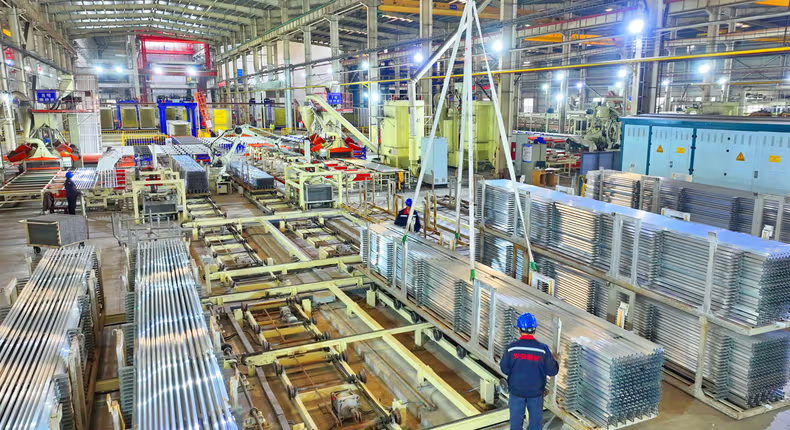










On the surface, the Ghana Stock Exchange may appear dominated by financials, telecoms, and consumer goods. Yet a quieter but meaningful trend has been unfolding — manufacturing stocks are steadily growing, attracting attention from strategic investors and long‑term holders alike.
Understanding why manufacturing equities are gaining traction helps investors balance portfolios and identify underappreciated opportunities in Ghana’s evolving capital markets.
As frequently analysed on The High Street Business, underlying economic shifts often illuminate investment trends before they show up in headlines. Here’s why manufacturing stocks are quietly growing.
📢 GET A DETAILED ARTICLES + JOBS
Join SamBoad's WhatsApp Channel and never miss a post or opportunity.
1. Rising Domestic Demand Fuels Local Production
Ghana’s expanding middle class and urban population have increased demand for locally produced goods — from food and beverages to building materials and consumer products.
As consumption grows:
-
Local manufacturers capture market share from imports
-
Revenues and earnings expand in a measurable way
This growth trajectory translates into improved financials for listed manufacturing firms and increased investor interest.
2. Import Substitution Reduces External Dependence
Import substitution — replacing imported goods with locally made alternatives — has gained attention in economic policy circles.
When businesses and households choose local products:
-
Manufacturers benefit from increased volumes
-
Foreign exchange pressures ease
-
Production becomes more predictable
Investors view this structural shift as supportive of manufacturing stocks’ long‑term fundamentals.
3. Value Chain Expansion and Backward Integration
Manufacturers are increasingly sourcing inputs locally rather than relying solely on imports.
Backward integration — where firms control more of their production chain — leads to:
-
Lower input costs over time
-
Greater operational control
-
Improved margin stability
This efficiency gain strengthens profitability and reinforces investor confidence.
4. Enhanced Operational Efficiency
Manufacturing firms that focus on efficiency — including technology adoption, workflow optimisation, and better supply chain management — often demonstrate stronger earnings growth.
Operational discipline supports:
-
Lower production costs
-
Higher output quality
-
Greater competitiveness
Over time, these performance improvements show up in financial results and, ultimately, stock valuations.
5. Dividend Potential Supports Long‑Term Holders
Many manufacturing companies on the GSE have track records of dividend payment. Dividends provide income even when share price appreciation is modest.
In slower markets, dividend yields can be an anchor for investor returns — especially when compared with volatile alternatives.
Manufacturing firms that combine stable earnings with dividend payout policies attract income‑focused investors.
6. Policy Support and Economic Diversification
Ghana’s broader economic strategy emphasises diversification beyond commodities and services.
Manufacturing contributes to:
-
Job creation
-
Value‑added production
-
Export expansion
Government incentives — such as tax breaks for selected sectors — can improve the investment climate for manufacturing companies, drawing attention from capital market participants.
7. Resilience in Economic Cycles
Compared to some sectors that are more sensitive to short‑term macroeconomic shifts, well‑managed manufacturing firms often demonstrate resilience over business cycles.
This steadiness appeals to investors seeking:
-
Consistency
-
Predictability
-
Lower volatility
Manufacturing stocks may not show explosive growth overnight, but they often deliver durable performance over time.
8. Improved Corporate Governance and Reporting
Manufacturers that embrace stronger governance practices and transparent financial reporting tend to attract more investor interest.
Clear communication around:
-
Earnings performance
-
Strategic investments
-
Dividend policy
-
Risk management
builds investor confidence and supports valuation expansion.
9. Institutional Interest Increasing
Institutional investors — including pension funds and asset managers — increasingly allocate capital to sectors with stable earnings and predictable cash flows.
Manufacturing fits this profile for many institutional mandates, particularly for long‑term investors seeking diversification beyond financial and consumer goods equities.
Conclusion From THSB
Manufacturing stocks on the Ghana Stock Exchange may be under the radar, but they are quietly posting gains and attracting strategic capital. Growth is supported by rising domestic demand, import substitution trends, efficient operations, dividend potential, and broader economic diversification efforts.
For investors with a long‑term horizon, manufacturing equities present an opportunity that combines stability with sustainable growth.
In a market where rapid speculation is rare, slow and steady often wins the race. Understanding why these stocks are growing empowers investors to make informed decisions and capture value that may not yet be fully priced into market benchmarks.
Source: The High Street Business
Disclaimer: Some content on The High Street Business may be aggregated, summarized, or edited from third-party sources for informational purposes. Images and media are used under fair use or royalty-free licenses. The High Street Business is a subsidiary of SamBoad Publishing under SamBoad Business Group Ltd, registered in Ghana since 2014.
For concerns or inquiries, please visit our Privacy Policy or Contact Page.