


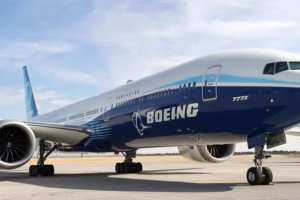








Boeing is betting more heavily on Africa’s aviation future.
The U.S. planemaker has raised its 20-year aircraft demand forecast for the continent by 40%, now projecting sales of 1,700 new aircraft, up from 1,200 last year and 1,000 three years ago. The revision reflects what executives describe as a structural acceleration in economic growth and air travel demand across African markets.
Single-aisle aircraft—typically deployed on short- and medium-haul routes—are expected to account for roughly two-thirds of total projected demand, underscoring the expanding role of intra-African connectivity and domestic travel.
📢 GET A DETAILED ARTICLES + JOBS
Join SamBoad's WhatsApp Channel and never miss a post or opportunity.
Growth Momentum Behind the Numbers
The upgraded outlook aligns with improving macroeconomic indicators.
According to the International Monetary Fund, sub-Saharan Africa’s economy is forecast to expand by 4.6% this year, outpacing the global average of 3.3%. Aviation demand, historically correlated with GDP growth, is benefiting from that differential.
Boeing expects passenger traffic across Africa to grow at an average annual rate of 6% over the next two decades. The drivers are demographic and structural: a young and expanding population, rapid urbanization, a growing middle class and continued investment in airport infrastructure.
In practical terms, that translates into more first-time flyers, stronger business travel between commercial hubs and rising tourism flows both within and beyond the continent.
Narrow-Body Dominance
The projected dominance of single-aisle jets highlights the continent’s evolving route structure.
African carriers are increasingly focused on high-frequency, point-to-point service connecting major cities and secondary markets. Aircraft in this category offer lower operating costs, greater flexibility and faster turnaround times—critical features for airlines operating in price-sensitive markets.
Wide-body aircraft will still play a role, particularly for long-haul routes linking Africa with Europe, the Middle East, Asia and North America. However, the bulk of growth is expected to be driven by regional and domestic expansion.
Market Share and Competitive Position
Boeing currently holds an estimated 70% share of the African commercial aviation market, positioning it as the dominant supplier on the continent. The upward revision in forecast demand therefore represents a potential multibillion-dollar opportunity over two decades.
Yet converting projections into deliveries remains complex.
The aerospace manufacturer has faced a series of production and regulatory challenges in recent years, including factory slowdowns, heightened oversight, financial strain and labor disruptions. These pressures have constrained output and delayed deliveries globally.
Ethiopian Airlines’ Expansion, Delayed
Among the airlines navigating these constraints is Ethiopian Airlines, widely regarded as Africa’s largest and most strategically ambitious carrier.
Based in Addis Ababa, the airline has built an expansive network connecting Africa to Asia, Europe and North America. Fleet modernization is central to that strategy. However, delivery delays from Boeing have complicated its expansion timetable.
Despite the disruptions, Ethiopian Airlines has ordered nine Boeing 787 Dreamliner aircraft to meet growing long-haul demand. The Dreamliner’s fuel efficiency and extended range make it particularly suited to intercontinental routes—a segment expected to benefit from Africa’s rising global trade and diaspora travel.
Delivery timing, however, will be critical. Aircraft delays can disrupt route launches, strain capacity planning and affect profitability.
Infrastructure and Industrial Ambitions
Beyond fleet acquisition, African governments are increasingly focused on developing local aviation infrastructure.
Nigeria has urged Boeing to establish one of the continent’s most advanced Maintenance, Repair and Overhaul (MRO) facilities within its borders. Such a facility would reduce reliance on overseas technical hubs, cut maintenance costs for regional carriers and strengthen aviation supply chains.
An MRO hub could also anchor broader aerospace industrial development, creating skilled jobs and positioning the country as a technical services center for West Africa.
For Boeing, closer industrial partnerships could deepen customer relationships while embedding the manufacturer more firmly within regional ecosystems.
Structural Tailwinds—and Structural Risks
Africa’s aviation story has long been described as one of untapped potential. The continent accounts for a disproportionately small share of global passenger traffic relative to its population size.
Structural barriers—fragmented markets, high operating costs, currency volatility and regulatory complexity—have historically constrained growth. Yet initiatives aimed at liberalizing airspace and expanding airport infrastructure are gradually reshaping the landscape.
Boeing’s revised forecast suggests confidence that these structural tailwinds will outweigh persistent risks.
Still, delivery constraints remain a near-term challenge. Production bottlenecks and regulatory scrutiny have slowed aircraft output globally. Airlines seeking rapid fleet expansion may face extended lead times, complicating growth strategies even as demand accelerates.
A Long-Term Bet
For Boeing, the 40% upward revision signals more than optimism; it represents a long-term strategic bet on Africa’s demographic and economic trajectory.
A continent with one of the world’s fastest-growing populations is steadily urbanizing. Rising incomes, expanding trade links and increased investment in tourism and infrastructure are converging to drive mobility demand.
If passenger traffic does grow at a 6% annual pace, Africa would emerge as one of the aviation industry’s most dynamic frontiers over the next two decades.
Yet execution will matter as much as projections. Aircraft orders must translate into timely deliveries, airlines must sustain profitability in volatile markets and governments must continue investing in infrastructure and regulatory harmonization.
For now, Boeing’s recalibrated forecast reflects confidence that Africa’s skies will become markedly busier—and that the next chapter of global aviation growth may be written increasingly from the continent.
Source: The High Street Business
Disclaimer: Some content on The High Street Business may be aggregated, summarized, or edited from third-party sources for informational purposes. Images and media are used under fair use or royalty-free licenses. The High Street Business is a subsidiary of SamBoad Publishing under SamBoad Business Group Ltd, registered in Ghana since 2014.
For concerns or inquiries, please visit our Privacy Policy or Contact Page.