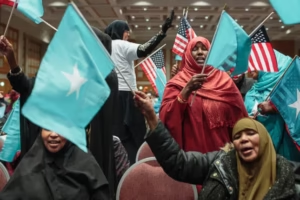







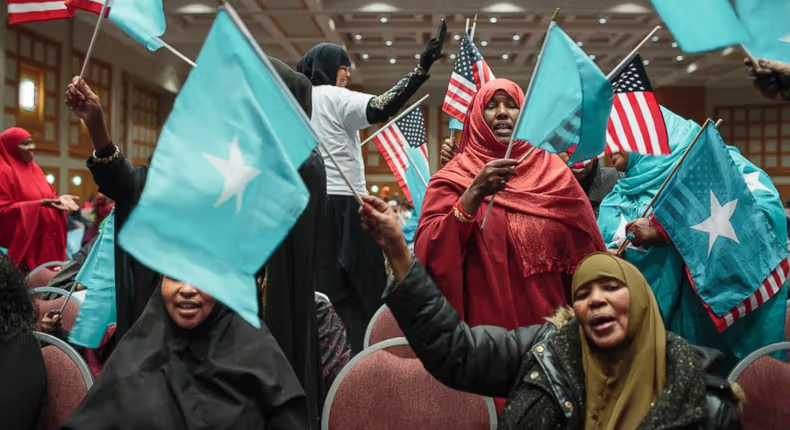
A legal challenge is mounting against the U.S. government’s plan to revoke humanitarian protections for more than a thousand Somali nationals living in the country, setting up a potentially consequential court battle over immigration policy and executive authority.
The lawsuit, filed in a federal court in Boston, argues that the decision by the U.S. Department of Homeland Security to terminate protections under the Temporary Protected Status program for Somali migrants is both discriminatory and procedurally flawed.
Four Somali individuals and two advocacy organizations—African Communities Together and Partnership for the Advancement of New Americans—are challenging the policy, claiming it unfairly targets the Somali diaspora and violates administrative law.
📢 GET A DETAILED ARTICLES + JOBS
Join SamBoad's WhatsApp Channel and never miss a post or opportunity.
The protections are currently scheduled to expire on March 17, 2026.
A Longstanding Humanitarian Policy
Temporary Protected Status, commonly known as TPS, was created by the United States in 1990 to offer temporary refuge to individuals from countries facing armed conflict, natural disasters, or other extraordinary crises.
Somalia was granted TPS in 1991 following the collapse of its central government and the outbreak of prolonged civil conflict. The designation has been repeatedly extended over the decades due to continued instability, including militant violence and humanitarian crises.
The new decision would mark the first time in more than three decades that Somali nationals would lose this protection.
Officials have argued that conditions in Somalia have improved sufficiently to justify ending the designation.
However, critics say the country remains plagued by insecurity, including ongoing attacks by the militant group Al‑Shabaab, as well as droughts and humanitarian challenges.
The Legal Argument
The lawsuit asserts that the termination decision was driven by political motivations rather than objective assessments of conditions in Somalia.
Plaintiffs also cite past remarks by Donald Trump that they argue demonstrate bias against Somali migrants and other immigrants from African nations.
According to the complaint, the policy reflects “a predetermined agenda” that disproportionately harms the Somali community, particularly those concentrated in the Midwestern state of Minnesota, home to one of the largest Somali diasporas in the United States.
Legal representatives say the case will test whether immigration decisions affecting vulnerable populations must adhere to procedural safeguards under U.S. administrative law.
Minnesota at the Center
The Somali community in Minnesota has long been a focal point of immigration debates in the United States.
Over the past year, federal enforcement activity targeting immigration violations has increased in the state. Authorities deployed thousands of immigration officers as part of investigations tied to an alleged fraud scandal involving several individuals from the community.
Those operations sparked protests among local residents and civil rights groups, who argued that the enforcement campaign unfairly stigmatized the broader Somali-American population.
Community leaders warn that ending TPS protections could expose many Somali residents to deportation or legal uncertainty, despite years of living and working in the United States.
A Broader Immigration Debate
The legal dispute reflects wider tensions in American immigration policy, where humanitarian protections often intersect with political and security considerations.
While TPS provides temporary legal status and work authorization, it does not offer a direct pathway to permanent residency or citizenship. Beneficiaries must rely on periodic renewals by federal authorities.
For Somali migrants, the potential termination of TPS after more than three decades represents a dramatic shift in policy.
Advocacy groups argue that Somalia’s ongoing instability makes deportation both dangerous and impractical, while supporters of the policy change say humanitarian protections should remain temporary rather than indefinite.
What Comes Next
The Boston federal court will now determine whether the government’s decision complied with legal procedures and constitutional protections.
If the plaintiffs succeed, the court could temporarily block the termination while the case proceeds, allowing Somali TPS holders to maintain their legal status.
If the challenge fails, however, thousands of Somali migrants may face an uncertain future once the protection officially expires in March 2026.
For policymakers and courts alike, the case underscores the increasingly complex intersection of humanitarian obligations, immigration enforcement, and domestic political debate in the United States.
Source: The High Street Business
Disclaimer: Some content on The High Street Business may be aggregated, summarized, or edited from third-party sources for informational purposes. Images and media are used under fair use or royalty-free licenses. The High Street Business is a subsidiary of SamBoad Publishing under SamBoad Business Group Ltd, registered in Ghana since 2014.
For concerns or inquiries, please visit our Privacy Policy or Contact Page.