









Nigeria is intensifying its push to reduce reliance on crude oil, signing a landmark agreement with the African Finance Corporation to jointly fund three strategic mining initiatives, including a $1.3 billion alumina refinery designed to anchor a broader industrial shift.
The Memorandum of Understanding, executed in Abuja, also covers a nationwide geoscience mapping program and the creation of a dedicated investment vehicle aimed at unlocking dormant mineral assets. The initiative signals one of the most ambitious attempts yet by Africa’s largest oil producer to reposition solid minerals as a core pillar of economic growth.
Building a Domestic Refining Base
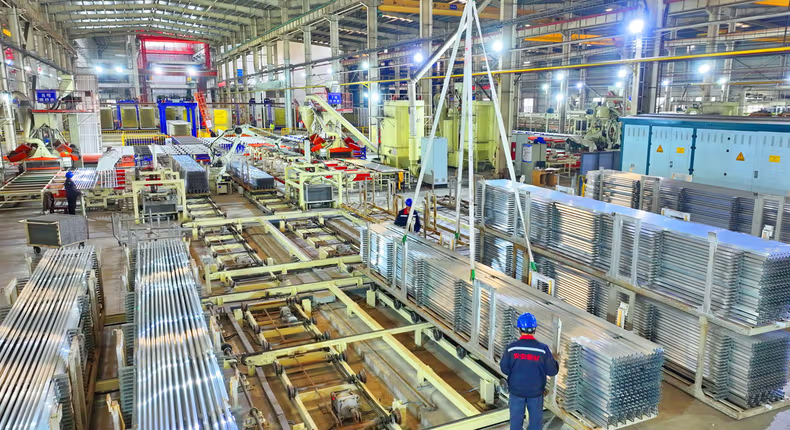
At the center of the agreement is a refinery designed to process roughly one million tonnes of bauxite annually using a modern Bayer-process flowsheet. The facility will be supported by an on-site gas-fired cogeneration plant to generate steam and electricity, ensuring operational stability in a country where power supply remains inconsistent.
📢 GET A DETAILED ARTICLES + JOBS
Join SamBoad's WhatsApp Channel and never miss a post or opportunity.
According to officials, the plant is expected to operate at approximately 95% utilization over a 20-year lifespan, producing an estimated 19 million tonnes of alumina. Projections attached to the project outline an annual GDP contribution of $1.2 billion, more than $25 billion in total lifecycle economic value and up to $8 billion in foreign-exchange earnings.
The agreement was signed between the Federal Government and the Solid Minerals Development Fund, reinforcing the government’s intention to institutionalize mining-sector financing rather than rely solely on private capital inflows.
A Strategic Pivot Beyond Oil
Nigeria has historically depended on crude exports for the majority of government revenue and foreign exchange. That concentration has repeatedly exposed the economy to oil-price volatility, currency pressures and fiscal instability.
In recent years, policymakers have sought to accelerate diversification efforts, identifying mining as a sector with significant untapped potential. The country possesses commercially viable deposits of bauxite, gold, limestone and other minerals, yet downstream processing capacity has remained limited.
Minister of Solid Minerals Development Dele Alake described the agreement as transformative, arguing it could materially increase mining’s contribution to national output. Executive Secretary Fatima Shinkafi characterized the project as the Solid Minerals Development Fund’s largest undertaking to date, pointing to growing investor confidence in the sector.
Africa’s Alumina Race
The refinery initiative also positions Nigeria within a broader continental shift toward beneficiation—processing raw minerals domestically rather than exporting unrefined ore.
Africa holds roughly 29% of global bauxite reserves yet accounts for less than 1% of global alumina refining capacity. As of 2020, approximately 75 alumina refineries were operating worldwide. The largest, Hydro Alunorte, has capacity of 6,300 kilotonnes per year. China leads globally with 27 active refineries, many controlled by state-owned enterprises such as Chinalco.
African producers are increasingly seeking to capture more value domestically. Guinea—the world’s largest bauxite exporter—has encouraged miners to invest in local refining capacity. Cameroon and Ghana are also advancing refinery projects valued at over $1 billion.
Nigeria, despite possessing meaningful bauxite deposits, has historically played only a marginal role in the alumina value chain. If executed at scale, the new facility could shift the country’s position from raw-material exporter to higher-value processor.
Economic Stakes and Execution Risks
The economic projections attached to the refinery are ambitious. An annual GDP contribution of $1.2 billion would represent a meaningful increment to non-oil output. Over two decades, the projected $25 billion in economic value and $8 billion in foreign-exchange earnings would strengthen fiscal buffers and reduce exposure to oil-market swings.
Yet execution will determine whether those gains materialize.
Large-scale industrial projects in Nigeria have historically faced delays linked to infrastructure gaps, financing constraints and regulatory bottlenecks. Reliable gas supply for the cogeneration plant, stable logistics chains for bauxite transport and consistent policy support will be critical.
Moreover, global alumina prices are cyclical, influenced by energy costs, Chinese demand and aluminum market dynamics. Sustaining 95% utilization over 20 years will depend on disciplined operations and competitive cost structures.
Unlocking Geological Potential
Beyond the refinery itself, the agreement’s geoscience mapping component could prove equally significant. Comprehensive geological surveys are foundational for attracting private investment. By improving data transparency and resource certainty, the government aims to reduce exploration risk and accelerate capital inflows.
The planned investment vehicle is intended to mobilize structured financing for mining assets, blending public backing with private participation. In theory, such a vehicle could crowd in institutional investors wary of early-stage geological risk.
A Long-Term Industrial Play
The refinery marks more than a single industrial asset; it signals a strategic recalibration. Nigeria’s economic model has long been anchored in upstream oil extraction. Moving downstream in the minerals value chain represents a structural shift toward manufacturing and industrialization.
For policymakers, the calculus is clear: exporting refined alumina rather than raw bauxite captures greater value, generates skilled employment and strengthens foreign-exchange reserves.
Whether Nigeria can translate ambition into sustained industrial capacity remains to be seen. But in aligning with the African Finance Corporation and formalizing a multibillion-dollar alumina project, the country has taken a definitive step into Africa’s intensifying race for mineral beneficiation.
Source: The High Street Business
Disclaimer: Some content on The High Street Business may be aggregated, summarized, or edited from third-party sources for informational purposes. Images and media are used under fair use or royalty-free licenses. The High Street Business is a subsidiary of SamBoad Publishing under SamBoad Business Group Ltd, registered in Ghana since 2014.
For concerns or inquiries, please visit our Privacy Policy or Contact Page.